Join the GOOGLE +Rubber Room Community
Showing posts with label Mike Antonucci. Show all posts

Saturday, March 14, 2020

The UFT Charter School Says "Basta Cosi, Grazie" ("That's Enough, Thank you" translated from the Italian)

How many people know that the UFT had a charter school?

Anyway, it doesn't matter anymore, as the school is closing due to mismanagement and staff discontent.

 Betsy Combier, betsy.combier@gmail.com
Editor, ADVOCATZ.com
Editor, NYC Rubber Room Reporter
Editor, Parentadvocates.org
Editor, New York Court Corruption
Editor, National Public Voice
Editor, NYC Public Voice
Editor, Inside 3020-a Teacher Trials 


From Mike Antonucci, E.I.A. Intercepts
R.I.P. UFT Charter School
Posted: 11 Mar 2020 11:51 AM PDT
Last month, New York City’s United Federation of Teachers announced it wanted to convert the charter school it founded in 2005 into a traditional public school. This brings to an end an era when teacher unions wanted to prove they could run schools better than those we hire to do the job.
I wrote about the UFT Charter School many times over the past 15 years, with my main focus being how quickly UFT could abandon its stated principles about schools and labor relations when it came to an enterprise it owned and managed.
We have seen this phenomenon when teacher unions negotiate with their own employees, and we saw it with NEA affiliates back when they were sponsoring charter schools.
How many ways did UFT circumvent its own rhetoric on charters?
* The UFT Charter School was funded by a corporate billionaire. The Broad Foundation gave the union $1 million over four years.
* They used some of the money to hire an outside consultant to “help us navigate the rules and regulations of the charter process,” according to then-UFT president Randi Weingarten.
* After an incident in which first-graders were forced to clean a bathroom, UFT summarily disciplined the school’s principal, though it was unclear whether she received adequate due process.
* Another principal resigned in 2008, “after clashing with teachers and union leaders,” according to this New York Times story. His tenure was defined by a number of problems that shouldn’t be associated with a union-run school, such as teachers who spoke with the Times anonymously “for fear that they would suffer professionally if they were named.”
* Weingarten downplayed the school’s difficulties, and pointed to standardized test scores as evidence of its success, even though she had previously stated that using standardized test scores to evaluate teachers and students “distorts and constricts our understanding of quality teaching and learning.” Her stance backfired two years later, when the state revamped its tests to counter inflated results. The UFT Charter School “showed one of the most severe declines, to 13 percent of eighth graders proficient in math, from 79 percent,” according to the Times.
* By 2011, the teacher turnover rate at the UFT Charter School had grown to 33 percent.
* In 2015, UFT closed the K-8 portion of the school and carried on the charter as a secondary school. In 2018, the teacher turnover rate was still 24 percent.
Chalkbeat NY hit the nail on the head when it reported that the UFT Charter School was “opened to prove a point.” That’s a bad reason to open any school. New York City should be careful it doesn’t allow UFT to make the same mistake with this proposed transition to a traditional public school.
“Our students, parents and teachers love their high school, and are proud of the individualized support our school gives our students, but they have told us that they want to be a part of a broader community,” said UFT president Michael Mulgrew.
This is a transparent attempt to lay the blame for the school’s history on its existence as a charter, and deflect the blame from the union’s oversight. It also rids the union of an albatross that interfered with its general anti-charter policies.
In a way, we will all benefit from teacher unions staying in their lane. Unions will be able to singularly devote themselves to labor representation, and the public will not have to endure them as management, a role for which they are poorly suited.

UFT analysis finds exclusion is key to results of the most successful charter schools

Charter schools as a group enroll a significantly smaller percentage than the public schools of English language learners, special education students or those from the poorest families.  A new UFT analysis of individual charter schools clearly shows that the schools most successful at excluding these kinds of students are the charters with the highest test scores.
For the 2018-19 school year, the latest for which city and state data are available, charters as a group enrolled half the citywide average of ELLs, significantly fewer students with disabilities – particularly those with the most challenging needs – and fewer students from the poorest families.
Chart 1: New York City Charters vs. New York City Traditional Public Schools
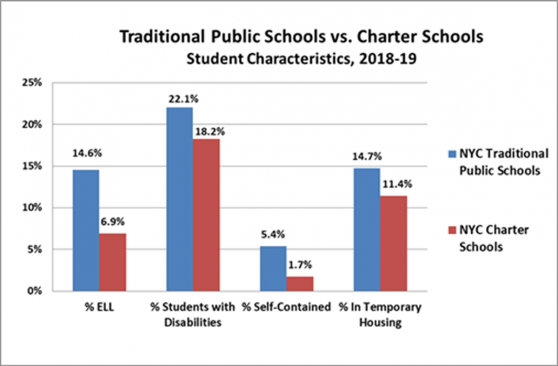
New York City Charters vs. New York City Traditional Public Schools
Source: 2018-19 School Quality Report, Elementary, K-8, Middle & High Schools

But even within the charter sector, the varying degree to which such students are excluded proves to be an important factor in individual charter school success.
Using the most recent state English language exam as a starting point, the UFT broke down the New York City charter sector into four groups: Tier 1 was the most successful, with a pass rate of 67% or higher; Tier 2 was charters with pass rates of 55% to 67%; Tier 3, 44% to 55%.
Tier 4 was made up of the nearly 50 charters that failed to reach even the citywide ELA average (raising the question that if charters are such a magical solution to school system woes, why do fully one-quarter of them lag behind the citywide average?)
As the table shows, Tier 1 charters have about half as many English Language Learners as the charters in Tier 4, only two-thirds the number of students with disabilities and significantly fewer students in poverty.
Chart 2: Charter Reading Scores and Student Demographics
 % ELA ProficiencySchool Count% English Language Learners% Students with Disabilities% Poverty
Tier 167.2% - 100.0%485.7%13.3%74.3%
Tier 255.1% - 67.1%487.0%13.3%74.3%
Tier 344.0% - 55.0%486.6%17.5%80.7%
Tier 415.5% - 43.9%489.6%22.5%83.5%
Source: NYC DOE 2018-19 Demographic Snapshot and Test Scores
How do charters – particularly the ones most successful on standardized tests – find ways to minimize the number of the neediest pupils?
While the charter admission process appears to be completely random, in fact the students in the pool from which charters draw have parents with a knowledge of the system and the motivation to enter their children in the charter lottery – a particularly high bar for immigrant parents and those whose first language is not English.
This phenomenon of family knowledge and commitment is not unique to charters, but has been found in national studies to be part of the apparent success of many parochial and private schools.
Robert Pondiscio, an author with many sympathies for the charter movement, wrote most recently in his book on Success Academy (“How the Other Half Learns”) that the idea that essentially the same kinds of students attend both public schools and charters, while “deeply satisfying to charter school advocates… is also misleading and even false” because parental motivation plays such a large role in what amounts to a self-selection process in charter -- and non-public school -- admissions.
Student attrition then plays an important role, at least in the most academically successful charters.
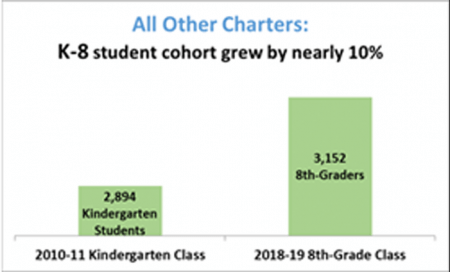
Our analysis of all K-8th-grade charters from the 2010-11 to 2018-19 school years shows that Tier 1 – the most academically successful group – had a loss of 26% of the students who started in the cohort in 2010. Meanwhile, the 2010 cohort in the less successful charters actually gained students.
Chart 3: Impact of Student Attrition
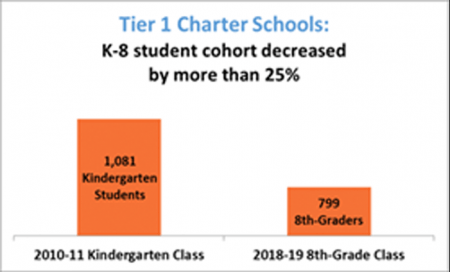
Impact of Student Attrition Chart - Tier 1 Charter Schools
Source: NYC DOE Demographic Snapshots, 2010 to 2018-19
Impact of Student Attrition Chart - All Other Charters
Source: NYC DOE Demographic Snapshots, 2010 to 2018-19
Given the data, it is hard to avoid the obvious conclusion that Tier 1 charters are consciously shedding academically struggling students – and reaping the results in terms of higher test scores. Only actual student academic records would refute such a conclusion, and it is unlikely that the charters will see it as in their interest to provide those records.
Given the high rate of student attrition, what role did suspensions or other disciplinary actions play in families’ decisions to leave? Repeated suspensions are a key tactic in persuading students and their families who do not fit in to find other schools (generally in the public system).
The charters certainly aren’t going to tell us. But state data shows that charters as a group suspended students far more frequently than public schools did, and that Tier 1 charters – with a suspension rate of more than 8% – led the way.
Chart 4: Suspensions: NYC Public Schools vs. NYC Charters
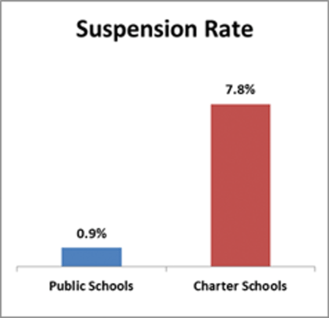
Suspensions: NYC Public Schools vs. NYC Charters
Student Suspension rate is determined by dividing the number of students who were suspended from school (not including in-school suspensions) for one full day or longer anytime during the school year by the Basic Educational Data System (BEDS) day enrollments for that school year. A student is counted only once, regardless of whether the student was suspended one or more times during the school year. Suspension data are lagged a year because data for the reporting year are reported in October following the close of that reporting year. Source: 2016 State Data, data.nysed.gov

The burden of charter costs

The charter sector consistently claims superior student results, while denying the effects of its exclusionary policies, particularly in the highest-scoring charter schools. Those misleading assertions have helped to drive the sector’s expansion to the point that an estimated $2.4 billion in city Department of Education funds will be diverted in Fiscal 2021 to charter operations.
This number is scheduled to grow as current charters – with no further regulatory or legislative action – expand their grades in future years to add as many as 50,000 more students.
Approximately 121 charter schools are now co-located in public school buildings, too often involving the loss of libraries, labs, music rooms and other facilities for the public school students involved. According to an estimate by the organization Class Size Matters, from 2014 to 2019, the total amount of public funds spent for co-located space and for charter school leases and lease assistance reached $377.5 million.
Yet these enormous public investments are going to many schools that exclude the neediest students – and rely on such exclusion to fuel their claims of success.
Related Topics: Research shows


Friday, October 13, 2017

The UFT Retro Payment Mess

Mike Antonucci, a prolific writer now giving his opinions on 74 on wednesdays, asks:

"So while public-sector unions must prepare for the consequences of members leaving unions entirely, they must also prepare to operate in a world where members easily move from one union to another, or to a non-union association. How ready are they for an actual marketplace in labor representation?"

The Supreme Court may, in it's Janus ruling, force changes to the way that the UFT does business.

This is a good move, if it stops the UFT bigwigs' misuse of money seen by the rank and file.

Betsy Combier


NYC Teachers Union Sows Confusion as It Delivers Raises, Double Dips on Dues by MIKE ANTONUCCI, The 74

It won’t buy a river view, but many New York City teachers and other school staff will receive a hefty paycheck this week, part of the back wages they’re owed for two years when they worked without a contract while other municipal workers enjoyed raises.

They won’t entirely be made whole, however, because their union, the United Federation of Teachers, deducts dues from retroactive pay even though it took out their annual dues for these same years at the time — a practice that dissenting members in the UFT described as double-dipping.

“It looked like we got double-duesed,” said Mindy Rosier, a special education teacher in Harlem, after an earlier retroactive payment in October 2015. At that time, Rosier’s normal dues deduction per paycheck was $54.17; that amount jumped to $91.58 when she received her retro pay.

“It’s a big, huge contract; there should be a reminder that, by the way … this is what we’re going to do,’ ” said Rosier, who was part of a slate that unsuccessfully challenged UFT’s leadership in the 2016 election. “I think they depend on [members being unaware] because I think if people remember, they’re afraid people will make a stink.”

UFT dues are “flat,” meaning all teachers are charged the same amount rather than a percentage of their salary. (Members with different job titles, like guidance counselors or secretaries, pay different amounts than teachers but the same as others who share their title.) A small but active population of teacher-activist bloggers has complained for years that flat rates impose a disproportionate burden on younger, lower-earning peers, but deductions on back pay appear to be infrequently discussed and poorly understood.

One theme among the online commentariat at the time of the October 2015 retroactive payment was the UFT’s purported need to hoard funds in advance of an expected U.S. Supreme Court decision abolishing mandatory fees — a judicial possibility that is today considerably closer at hand and weighing on unions nationwide.

“Perhaps part of the deal was that since UFT is taking a bigger slice of dues with these retro payments, they wanted to secure some future dues-paying in case many teachers bail if we become a Right to Work state. Slick,” said an anonymous but representative commenter on an NYC teacher blog at the time.

When asked by a teacher earlier this year if additional dues would be deducted from this October’s retroactive pay, a UFT phone representative identified a similar but more local reason for the UFT to bolster its reserves.

“I can’t say yes or no because it could be yes, it could be yes, it could be no, because it all depends on what the executives feel, you know,” he said. “They don’t want to go to the hassle and just say no and they might say yes, well, they need the money because a lot of stuff politically — we need to send money for whatever we need to, because we got to get ready for the next negotiation, right?”

This week’s additional wage boost — a 2 percent increase on 2009 and 2010 salaries — was negotiated as part of the UFT’s 2014 collective bargaining agreement. Mayor Bill de Blasio agreed to compensate UFT members for the difference between their actual earnings since 2009, when the last contract expired, and what they would have earned if given the same increases that went to members of most city unions.

The mayor’s spokeswoman, Freddi Goldstein, said this week, “This is between the union leadership and its members,” declining to comment further. The Department of Education did not respond to several requests for comment.

The payout will be the second of five spaced between 2015 and 2020 because the city couldn’t afford to pay the entire amount at once. Educators will receive between several hundred and several thousand dollars; exact figures for this round are unclear because the Department of Education’s payroll portal, which allows employees to view paychecks a few days early, was taken down Tuesday after displaying “incorrect deduction information” with regard to UFT charges, the union said. The deductions “appeared to have doubled. This information is incorrect,” according to the union.

Pay stubs from several teachers for the October 2015 retro payment show union deductions going up by as much as $37.27, a nearly 70 percent increase. During that period, the city’s payroll portal crashed — apparently from so much activity.

Finding correct information this year may not have been easy either. Multiple calls to dedicated UFT hotlines yielded confused and apparently incorrect explanations, according to a teacher who is also the UFT chapter leader at a school.

“Union dues has nothing to do with the retro payment,” one specialist told the teacher. She wrongly explained that dues are proportional to earnings. “Obviously, since you are only being paid part [of what you would have earned] in 2009 and 2011, not enough dues was taken out of your check at that time, do you follow me?” she said. “So when I’m looking here, I can see this is pro-rated of what you were owed, now what you owe, what you should have been paid in union dues 2009 to 2011. Did you understand my mumbo jumbo?”

The UFT says its approach is commonsensical. “Retro and lump sum payments are in effect wages,” spokesman Dick Riley said in a statement this week. “As such, the UFT has traditionally deducted dues from lump sum/retro payments, just as taxes, Social Security, and benefits are deducted.”

Riley said the annual flat-rate structure results in dues collections that are “slightly below the maximum possible” using the union’s formula for calculating deductions. “For computational simplicity, the UFT determined to collect dues on the lump sum payments on the basis of the approved .85 rate rather than the flat rate.”

“Computational simplicity” does not spring to mind when contemplating the union dues calculations; the annual fee is a product of internal decisions dating back to 1982 that tie it to the UFT’s second-highest level in the salary structure, know as 8B plus L20, the latter number indicating 20 years of service. The “maximum possible” rate would instead use the highest salary (8B plus L22) as the basis for dues. Currently, a new teacher with only a bachelor’s degree earns $45,530 and pays dues based on a percentage of $95,202, the maximum 20-year salary. Teachers with greater experience and education, whose salaries may exceed $95,202, also pay dues on that amount.

A small part of dues, which as of Wednesday were deducted in semi-monthly payments of $56.65, or $1,359.60 annually, goes to the UFT’s state and national affiliates.

It’s not clear why the Department of Education calculates retroactive dues based on a percentage of how much each member receives, rather than using the year-to-year flat rate. What is certain, according to current and former chapter chairs, is that apart from the small number who are politically engaged in union issues, teachers are largely unconcerned with the added-on dues.

“What they’re losing is an almost unnoticeable thing for individual teachers,” said Evan Stone, co-CEO of the teacher advocacy group Educators for Excellence. “I think the average teacher would say, ‘The union got me this money. It makes sense that I would pay the same dues that I paid on the rest.’ ”

The UFT did not respond to requests for the total amount of dues deducted from this week’s retroactive payment or from the 2015 payment. It’s also not clear what the union will take in from additional dues charged during the retroactive payments in 2018, 2019 and 2020 (there was no retroactive increase given in 2016). There are 120,000 active UFT members, “most” of whom, the union said, qualified for retroactive raises.

Three union hotline specialists assured a teacher in recent months that any news about dues relating to the October 2017 payment would be in New York Teacher, the UFT’s journal, which did not appear to happen. A seven-paragraph announcement before the 2015 payment said, “All payroll contributions and deductions will be updated.”

With neither chapter leaders nor UFT service reps able to explain dues obligations, at least one veteran union-watcher says the teachers union makes it too difficult to understand many of its money-related decisions.

“This is an organization that is super close to the mayor and super powerful in New York City politics,” said Bill Hammond, of the right-leaning Empire Center for Public Policy. “One of the reasons it’s powerful is that it has so much money to spend. They’re doing this kind of mysterious thing with dues when arguably they have no right to back dues at all. Why would they feel the need to do something like this?”

Reporter Mareesa Nicosia contributed to this report.

Disclosure: David Cantor served as press secretary for the New York City Department of Education from 2005 to 2010.


Janus v. AFSCME: Lawyers in Key Union Case Appeal to U.S. Supreme Court for 2017–18 Hearing


Everyone and his brother in the education policy world spent Tuesday morning watching Secretary of Education Betsy DeVos testify before the Senate Appropriations subcommittee. But while that D.C. showdown was streaming live, attorneys for the plaintiff in the case of Janus v. AFSCMEwere quietly making it official and filing for review by the U.S. Supreme Court.
It’s the latter story that will have broader ramifications. If, as widely expected, the court ultimately rules in favor of Mark Janus, it will put an end to the practice of public sector unions charging agency fees to non-members.
Since only four justices are required to grant a writ of certiorari, it is virtually certain the case will be accepted for the court’s next session, beginning in October. Barring unforeseen delays, oral arguments should be heard in the winter and a ruling issued by June 2018.
Janus works for the Illinois Department of Healthcare and Family Services. In a statement, he explained why he brought his case: “To keep my job at the state, I have to pay monthly fees to the American Federation of State, County and Municipal Employees, a public employee union that claims to ‘represent’ me,” Janus says. “I’m filing this case on behalf of all government employees who want to serve their community or their state without having to pay a union first.”
Government workers in 20 states, including public school teachers, are required to pay agency fees if they choose not to join the union. Should the U.S. Supreme Court rule in favor of Janus, teachers unions estimate they could lose between 20 percent and 40 percent of their membership in those states.
As I reported last week: The National Education Association has modified its proposed budget for 2017–18 to include an estimated loss of 20,000 full-time equivalent members. This seems accurate because even larger losses won’t be felt until the 2018–19 school year. The California Teachers Association’s executive director recently warned activists to be prepared for membership losses as high as 30 percent to 40 percent. Despite his alert, CTA does not seem to have made any adjustments to its own 2017–18 budget. The United Federation of Teachers’ New York City local estimates a 20 percent reduction in membership and feels it can safely cut $16 million, which is about 10 percent of the annual dues it collects. Read my full analysis of how unions are bracing for the fallout.

Thursday, March 2, 2017

The UFT Financial Affairs Don't Make Sense

UFT President Mike Mulgrew and NYC Mayor Bill de Blasio
Norm Scott's blogpost Saturday, March 18, 2017:

NYSUT Blues - Dire Finances and ST Criticism of Non-Union Consultant


Analysis—New York’s Teachers Unions Are Millions in the 
Red: A Look at the Numbers
Mike Antonucci, March 1, 2017
LINK
Public schools in New York are among the best-funded in the nation, with the average spending per pupil exceeding $20,000 annually both in New York City and statewide. Not coincidentally, New York is also home to the largest state teachers union, New York State United Teachers, and the largest teachers union local, the United Federation of Teachers, in New York City.

Besides advocating for their members, the unions are also commercial enterprises operating in a market economy. They have buildings, employees, bills to pay, budgets to construct, and in-house “staff unions” they have to bargain with. It is instructive to compare the teachers unions’ positions for financing public schools with the way they collect and disburse funds internally.
For instance, unions spend heavily on employee salaries and benefits — to the point of risking their future solvency. If a new court challenge similar to the Friedrichs case results in the end of agency fees — required union payments by non-members to compensate for collectively bargained benefits — the New York unions may find themselves unable to meet their obligations to members and employees alike.
The unions’ public policy agenda is designed to mitigate those risks, but ir would have the effect of placing the public treasury in similar straits.
That’s because most union revenue comes from member dues. These tend to increase along with increases in average teacher salary, either according to an established formula or by the vote of a body representing the entire membership. NYSUT collected almost $133 million in dues during the 2015–16 school year, an increase of 5 percent over the year before, according to its annual disclosure reports with the Department of Labor.
UFT received $151 million in dues in 2015–16, a one-year increase of 5 percent.
Dues are a dependent source of revenue, however. As long as New York’s public schools hire additional teachers each year, and average teacher salaries increase, the unions’ income increases. No other legislative action or market condition has more than a marginal effect on union finances.
Having collected substantial sums, how do NYSUT and UFT spend them?
Most of it goes to their officers and staff. NYSUT employed around 550 people (according to its most recently available tax filing) with a payroll of $60 million. That sum is trivial, however, compared with the union’s liability for post-retirement benefits. NYSUT estimates that it is on the hook for $504 million in health care for retired members and pension costs, according to its 2016 labor department report, an increase of 31 percent from the year before and 135 percent from 2010.
From 2010 NYSUT Organization Report — Dept of Labor:
 
Six years later, the union’s liability for retiree benefits and pensions had risen by 135 percent:
UFT had 690 employees and a payroll of $42 million in 2015–16; it ran up large post-retirement liabilities of $77 million — a one-year increase of more than 25 percent and a 30 percent increase since 2010.
The unions boast of their success in stifling efforts to reduce public employee pension costs, but NYSUT would have to devote its entire income for more than three years just to cover the cost of its own employees’ pensions and retiree benefits.
How will the unions remain solvent given their precarious current state? So far they’ve relied on deficit spending. Annual deficits have reduced NYSUT’s net assets to –$413 million, according to its most recently available federal tax filings. UFT managed a surplus in 2014–15 after a deficit the previous year, but its net assets were –$19 million.
Here’s another possible indicator of the union’s financial insecurity: UFT owes NYSUT almost $11 million for back dues, and $4 million of that is 90 to 180 days past due. This suggests — we would know for sure only if the unions were more transparent about their financial activity — UFT has at least a temporary cash flow problem.
“The UFT is confident it will meet its future obligations,” UFT spokesman Dick Riley said in an email.
If the UFT is having financial troubles, NYSUT, which declined to comment, can’t afford to bail it out. And if NYSUT is having financial troubles, its parent organization, the American Federation of Teachers, couldn’t afford to bail it out either, because about 40 percent of AFT’s income is the dues paid by those same NYSUT members. In other words, AFT doesn’t have enough members in the rest of the country to cover NYSUT’s losses.
In the public sphere, the New York unions will consistently demand higher taxes, but when it comes to their own affairs, they recognize the risks of repeatedly going to the well, i.e., proposing additional dues increases to membership. They prefer to run up debt rather than reduce expenditures or raise dues to a level that would cover their spending.
We should approach the unions’ prescriptions for public finances with skepticism until they cure their own budgetary ills.
Mareesa Nicosia contributed to this story.
E-mail tips to mike@the74million.org

Teachers union spent millions on baseball, retreats and food

Carl Campanile, NY POST, January 9, 2017
Mike Mulgrew

It takes more than just a shiny apple to satisfy the city’s teachers union, which is spending member dues at a furious pace.
The United Federation of Teachers has blown through millions of dollars on fancy catered meals, tens of thousands of dollars on Yankees and Mets tickets, and big bucks on trips to destinations like Orlando, New Orleans and Las Vegas, records show.
Overall, the UFT boosted annual spending by more than $13 million in its fiscal year ending June 30, 2016 — from $168.7 million to $182.1 million, matching the entire budget of the city of Albany.
That includes the generous salaries of top UFT brass. Seven UFT staffers make more than $200,000 a year, and six of those exceed the $227,000 salary of Schools Chancellor Carmen Fariña.
Union boss Mike Mulgrew, for example, got a 3.8 percent pay hike and earns $283,804 — more than Mayor de Blasio.
Sixty-five staffers’ salaries cleared $150,000, nearly double the $80,000 to 85,000 salary of veteran teachers with 10 years’ experience.
And the big salaries are bolstered by pricy perks.
More than $3 million was spent on events catered by famous restaurants, while $1 million-plus was spent for member-training retreats at the Hilton Westchester in Rye, which describes itself as “country club cool.”
Mulgrew and other UFT staffers also paid thousands to attend conventions on union business and career and technical-education meetings, including $27,224 spent at the DoubleTree Hilton in Orlando, Fla. a union spokesman said.
Its membership increased last year from 180,145 to 187,157, thanks in part to new teachers hired under de Blasio’s universal pre-K program.
That membership increase led to a 5 percent increase in revenues, from $143 million to $151 million. Each member pays $56 twice a month in dues. The union also gets money from grants and rents on its properties.
Other than the perks, much of the union’s spending aims to protect its political clout. Donations to community and advocacy groups jumped from $2.3 million to $3 million, a report filed with the US Labor Department said.
The union gave $207,977 to ACORN, New York Communities for Change, which opposes charter schools, as well as $10,000 to Bertha Lewis’ Black Institute.
A pro-charter school group slammed the spending.
“It’s no wonder that, just before Christmas, the mayor went along with the teachers unions’ new performance-evaluation plan that will eliminate the last independent check on teacher performance,” said Jeremiah Kittredge, CEO of Families for Excellent Schools.
Mulgrew defended the spending.
“We are proud of every nickel we spend on — and on behalf of — our members,” he said.
”Defending public education is increasingly expensive.”

 UFT spends millions on dinners, parties, parking, coffee as thousands of teachers face layoffs
DOUGLAS FEIDEN, DAILY NEWS STAFF WRITER, February 24, 2011
As nearly 5,000 city teachers face the ax, their union shells out millions of dollars on feasting, boozing and partying, the Daily News has learned.
Free-spending United Federation of Teachers brass last year spent nearly $1.4 million for the UFT's 50th anniversary gala at the Hilton - complete with a movie, a book and a paperweight.

Records show they:
·        Ponied up $514,000 to 16 separate caterers.
·        Dropped $278,417 on the annual Teachers Union Day ceremony at the Waldorf-Astoria.
·        Bought $6,100 in gift baskets from a lower East Side candy store - and plowed $179,000 into training retreats at a Connecticut resort boasting golf, scuba diving and aqua aerobics.
In one amazing feat of spending, they shelled out $114,870 for annual "coffee supplies" at their five offices across the city - paying the Coffee Distributing Corp. on Long Island $324,000 over three years, records show.
And while most New Yorkers spend hours trying to find a parking space, the UFT rents 25 slots in Brooklyn's Renaissance Plaza Garage for members at an average annual cost of $75,000 over three years.
"I'm not going to apologize for spending money to service our members," said UFT President Michael Mulgrew.

"These people are heroes dedicated to making a difference in the lives of our children. They never get the respect they deserve. A cup of coffee, a bottle of water and a few parking spots is the least we can do for them."
The $284,078-a-year union boss got a little more than coffee when he took the reins in August 2009: The UFT feted him with a $6,400 "Welcome, Michael" party at a Brazilian steakhouse.
Mulgrew describes it as dinner for 130 union members, most of them volunteers, that came to barely $50 a head.
Three months later, the union bid farewell to his predecessor, Randi Weingarten, with a goodbye bash at the Tribeca Grill. Price tag: $8,339. "Mayor Bloomberg came and I tried to get him to pay," Mulgrew said. "Wouldn't do it."
Drawing from an annual honeypot of $126 million in members' dues, the union last year flung open the spigots even as it took fire for protecting dismal teachers and fighting reforms.
"These are wasteful, fantastic and outrageous expenditures, and they learned their profligate ways from the governmentspenders they negotiate with," said Sol Stern, a Manhattan Institute scholar and veteran education advocate.
Not Paris, but it is the Hilton
The spending orgy comes to light a week after after The News disclosed that cops bounced 24 rowdy UFT reps from an Albany eatery after they caused a ruckus over an $1,800 tab - and the modest size of a $40 gourmet quail.
Turns out over-the-top spending and a party-hearty culture is a union trademark.
Documented in the UFT's 2010 annual report to the U.S. Labor Department are details of the union's "Golden Jubilee," a gala bash last March that drew 2,500 members of the "UFT family."
It cost to $679,246 for the event at the Hilton New York.
To mark the milestone for posterity, a CUNY TV Foundation crew was paid $220,000 to film the documentary "UFT: Celebrating 50 Years," and all attendees got a DVD.
The UFT paid a printer $262,406 for a special book and anniversary journal. Paperweights emblazoned with the UFT logo cost $46,333. Balloons, $20,000 for entertainment and other expenses brought the tally to $1.4 million, filings show.
The UFT says it recouped $125,000 by charging members $50 a head, and donations from vendors and advertisers brought in an additional $275,000. Bottom line: That left the UFT out $1 million for the gala.
"We're very proud of the work we've done in 50 years as a union, and it deserved to be celebrated with dignity and respect," Mulgrew said.

dfeiden@nydailynews.com

Betsy Combier
betsy.combier@gmail.com
Editor, NYC Rubber Room Reporter
Editor, Parentadvocates.org
Editor, New York Court Corruption
Editor, National Public Voice
Editor, NYC Public Voice
Editor, Inside 3020-a Teacher Trials