Anyway, it doesn't matter anymore, as the school is closing due to mismanagement and staff discontent.
Betsy Combier, betsy.combier@gmail.com
Editor, ADVOCATZ.com
Editor, NYC Rubber Room Reporter
Editor, Parentadvocates.org
Editor, New York Court Corruption
Editor, National Public Voice
Editor, NYC Public Voice
Editor, Inside 3020-a Teacher Trials

From Mike Antonucci, E.I.A. Intercepts
R.I.P. UFT Charter School
Posted: 11 Mar 2020 11:51 AM PDT
Last month, New York City’s United Federation of Teachers announced it wanted to convert the charter school it founded in 2005 into a traditional public school. This brings to an end an era when teacher unions wanted to prove they could run schools better than those we hire to do the job.
I wrote about the UFT Charter School many times over the past 15 years, with my main focus being how quickly UFT could abandon its stated principles about schools and labor relations when it came to an enterprise it owned and managed. We have seen this phenomenon when teacher unions negotiate with their own employees, and we saw it with NEA affiliates back when they were sponsoring charter schools. How many ways did UFT circumvent its own rhetoric on charters? * The UFT Charter School was funded by a corporate billionaire. The Broad Foundation gave the union $1 million over four years. * They used some of the money to hire an outside consultant to “help us navigate the rules and regulations of the charter process,” according to then-UFT president Randi Weingarten. * After an incident in which first-graders were forced to clean a bathroom, UFT summarily disciplined the school’s principal, though it was unclear whether she received adequate due process. * Another principal resigned in 2008, “after clashing with teachers and union leaders,” according to this New York Times story. His tenure was defined by a number of problems that shouldn’t be associated with a union-run school, such as teachers who spoke with the Times anonymously “for fear that they would suffer professionally if they were named.” * Weingarten downplayed the school’s difficulties, and pointed to standardized test scores as evidence of its success, even though she had previously stated that using standardized test scores to evaluate teachers and students “distorts and constricts our understanding of quality teaching and learning.” Her stance backfired two years later, when the state revamped its tests to counter inflated results. The UFT Charter School “showed one of the most severe declines, to 13 percent of eighth graders proficient in math, from 79 percent,” according to the Times. * By 2011, the teacher turnover rate at the UFT Charter School had grown to 33 percent. * In 2015, UFT closed the K-8 portion of the school and carried on the charter as a secondary school. In 2018, the teacher turnover rate was still 24 percent. Chalkbeat NY hit the nail on the head when it reported that the UFT Charter School was “opened to prove a point.” That’s a bad reason to open any school. New York City should be careful it doesn’t allow UFT to make the same mistake with this proposed transition to a traditional public school. “Our students, parents and teachers love their high school, and are proud of the individualized support our school gives our students, but they have told us that they want to be a part of a broader community,” said UFT president Michael Mulgrew. This is a transparent attempt to lay the blame for the school’s history on its existence as a charter, and deflect the blame from the union’s oversight. It also rids the union of an albatross that interfered with its general anti-charter policies. In a way, we will all benefit from teacher unions staying in their lane. Unions will be able to singularly devote themselves to labor representation, and the public will not have to endure them as management, a role for which they are poorly suited. UFT analysis finds exclusion is key to results of the most successful charter schools Charter schools as a group enroll a significantly smaller percentage than the public schools of English language learners, special education students or those from the poorest families. A new UFT analysis of individual charter schools clearly shows that the schools most successful at excluding these kinds of students are the charters with the highest test scores.
For the 2018-19 school year, the latest for which city and state data are available, charters as a group enrolled half the citywide average of ELLs, significantly fewer students with disabilities – particularly those with the most challenging needs – and fewer students from the poorest families.
Chart 1: New York City Charters vs. New York City Traditional Public Schools
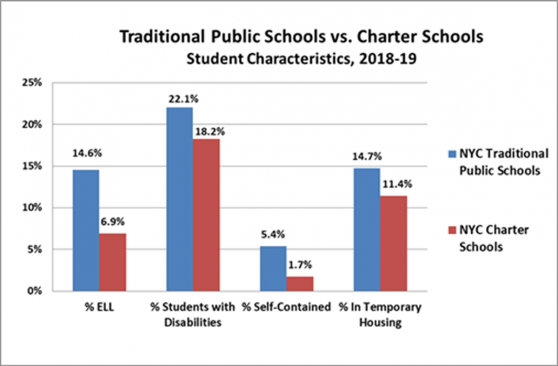 But even within the charter sector, the varying degree to which such students are excluded proves to be an important factor in individual charter school success. Using the most recent state English language exam as a starting point, the UFT broke down the New York City charter sector into four groups: Tier 1 was the most successful, with a pass rate of 67% or higher; Tier 2 was charters with pass rates of 55% to 67%; Tier 3, 44% to 55%. Tier 4 was made up of the nearly 50 charters that failed to reach even the citywide ELA average (raising the question that if charters are such a magical solution to school system woes, why do fully one-quarter of them lag behind the citywide average?) As the table shows, Tier 1 charters have about half as many English Language Learners as the charters in Tier 4, only two-thirds the number of students with disabilities and significantly fewer students in poverty. Chart 2: Charter Reading Scores and Student Demographics
Source: NYC DOE 2018-19 Demographic Snapshot and Test Scores
How do charters – particularly the ones most successful on standardized tests – find ways to minimize the number of the neediest pupils?While the charter admission process appears to be completely random, in fact the students in the pool from which charters draw have parents with a knowledge of the system and the motivation to enter their children in the charter lottery – a particularly high bar for immigrant parents and those whose first language is not English. This phenomenon of family knowledge and commitment is not unique to charters, but has been found in national studies to be part of the apparent success of many parochial and private schools. Robert Pondiscio, an author with many sympathies for the charter movement, wrote most recently in his book on Success Academy (“How the Other Half Learns”) that the idea that essentially the same kinds of students attend both public schools and charters, while “deeply satisfying to charter school advocates… is also misleading and even false” because parental motivation plays such a large role in what amounts to a self-selection process in charter -- and non-public school -- admissions. Student attrition then plays an important role, at least in the most academically successful charters. Our analysis of all K-8th-grade charters from the 2010-11 to 2018-19 school years shows that Tier 1 – the most academically successful group – had a loss of 26% of the students who started in the cohort in 2010. Meanwhile, the 2010 cohort in the less successful charters actually gained students. Chart 3: Impact of Student Attrition 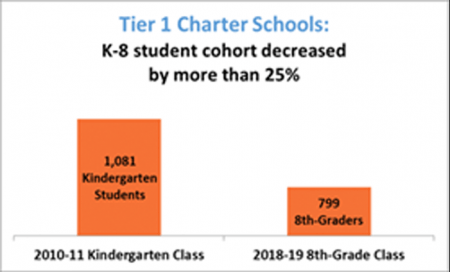 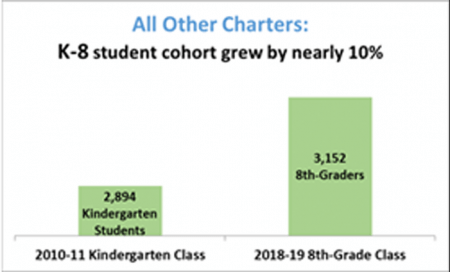
Given the data, it is hard to avoid the obvious conclusion that Tier 1 charters are consciously shedding academically struggling students – and reaping the results in terms of higher test scores. Only actual student academic records would refute such a conclusion, and it is unlikely that the charters will see it as in their interest to provide those records.
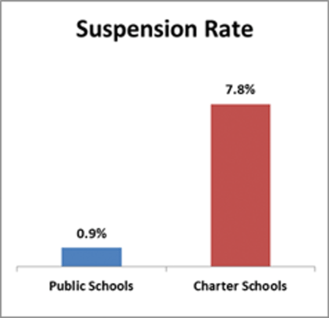
Given the high rate of student attrition, what role did suspensions or other disciplinary actions play in families’ decisions to leave? Repeated suspensions are a key tactic in persuading students and their families who do not fit in to find other schools (generally in the public system). The charters certainly aren’t going to tell us. But state data shows that charters as a group suspended students far more frequently than public schools did, and that Tier 1 charters – with a suspension rate of more than 8% – led the way.
Chart 4: Suspensions: NYC Public Schools vs. NYC Charters
 The burden of charter costsThe charter sector consistently claims superior student results, while denying the effects of its exclusionary policies, particularly in the highest-scoring charter schools. Those misleading assertions have helped to drive the sector’s expansion to the point that an estimated $2.4 billion in city Department of Education funds will be diverted in Fiscal 2021 to charter operations.This number is scheduled to grow as current charters – with no further regulatory or legislative action – expand their grades in future years to add as many as 50,000 more students. Approximately 121 charter schools are now co-located in public school buildings, too often involving the loss of libraries, labs, music rooms and other facilities for the public school students involved. According to an estimate by the organization Class Size Matters, from 2014 to 2019, the total amount of public funds spent for co-located space and for charter school leases and lease assistance reached $377.5 million. Yet these enormous public investments are going to many schools that exclude the neediest students – and rely on such exclusion to fuel their claims of success.
Related Topics: Research shows
|


