Join the GOOGLE +Rubber Room Community

Tuesday, May 11, 2010

We Shouldn't Want The Race To The Top Money

The new agreement tying test scores to teacher evaluations is a bad idea if the process has no oversight and no educator managing principals whose prejudice is to put children last.

As New York City has no one at the helm of the New York City Board of Education who cares about children and wants to promote curricula that is rigorous and high quality at all grade levels, this "agreement" will lead to a new disaster in city schools.

Here is a scenario for you to consider:

A Principal I will call "Evilness" assigns you, a teacher, to a classroom of 25 of the most difficult kids in the school: children who have disabilities involving behavior/anger management, dysgraphia, hearing loss; students at different grade levels in the English As a Second Language program, and a mix of other children each with unique needs, none of which are being addressed by the school (1:1 paraprofessionals, OT and/or speech pullout, remedial math help/resource room). You have to do your best, and you are a dedicated teacher, so you work at providing a safe as well as academically challenging environment for the children.

Unfortunately, you complained to the Principal last June that you objected to the way Evilness assigned students for this year. Your daily life in the school ever since then has been rotten, with harrassing behavior coming your way on a daily basis from the Principal. You are worried about your job.

You do everything that the Principal asks you to do, including giving a test every friday, and, as this is a third grade class, all the standardized tests and test prep that is required. You realize that no matter how well you teach to the test that about half of the class will not be able to do well, despite your best efforts.

For the first time you consider secretly changing the scores upward of those kids who dont do well towards the end of the year. You must do this, or, due to the fact that your previous year ended with not very good test scores for the exact same reason, you will be re-assigned and sent to a hearing for incompetence. You may lose your license.

You cannot sleep at night thinking about how you must scrub the tests, or you will be held accountable for the test scores of your class, when the scores are not directly your fault, but a fault of the Principal who is sabotaging your rights as an excellent, dedicated teacher.

The children will be promoted without proper assistence to handle the work in the higher grade in the Fall, but changing their grades is the only way you will be able to keep your job.

This can happen.

Why do we want this? For $700 million that we will never know to whom it is given?

Betsy Combier

May 10, 2010
Agreement Will Alter Teacher Evaluations
By JENNIFER MEDINA, NY TIMES

The State Education Department and New York’s teachers’ unions have reached a deal to overhaul teacher evaluations and tie them to student test scores, brokering a compromise on an issue the unions had bitterly opposed for years.

The agreement, reached in time for the state’s second bid at $700 million in federal education grants, would scrap the current system whereby teachers were rated simply satisfactory or unsatisfactory. Instead, annual evaluations would place teachers in one of four categories — highly effective, effective, developing and ineffective. While the deal would not have any immediate effect on teacher pay, it could make it easier for schools to fire teachers deemed subpar.

“We believe that if done correctly this will change the landscape dramatically,” said David M. Steiner, the state education commissioner. “This is not a gotcha system. This is about creating professional development that can really improve education.”

Teachers would be measured on a 100-point scale, with 20 percent points based on how much students improve on the standardized state exams. Another 20 percent would be based on local tests, which would have to be developed by each school system. After two years, 25 percent would be based on the state exams and 15 percent would come from the local tests.

The remainder of the evaluation will come from observations from principals and other teachers, and other measures. If teachers are rated ineffective for two consecutive years, they would face firing through an expedited hearing process that must conclude within 60 days. Currently hearings can drag on for several months.

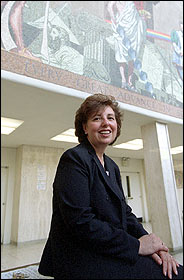
The changes, which Mr. Steiner, his deputy John King and Merryl H. Tisch,(at right) the chancellor of the State Board of Regents, described in an interview on

Monday, are subject to approval by the State Legislature. Ms. Tisch said they needed lawmakers to approve a package of education legislation within the next 10 days, so that the state could meet the June 1 application deadline for the federal competition known as Race to the Top.

New York did not win one of the first Race to the Top grants. Last week, the State Senate voted to more than double the number of charter schools in the state, another move aimed at winning Race to the Top money. The Assembly has not voted on that issue, though pro-charter advocates have been furiously lobbying and running advertisements.

Testing data would be used for only a fraction of the teachers in the state, because many teachers instruct in subjects or grades that do not have an annual exam. Mr. Steiner and Ms. Tisch have criticized the state exams, saying they may have become too easy and predictable in the last several years. But Mr. Steiner said that they were “not useless,” and that the department was taking steps to improve them, including changes this year that broadened the material covered by the tests.

Lawmakers are likely to approve the changes if they are backed by the teachers’ unions. But Mr. Steiner said it remained unclear if the state was out of “choppy waters.”

The unions — the New York State United Teachers and the United Federation of Teachers, the city’s union — did not gain any clear benefit from the deal, other than shielding themselves from criticism that they were hurting the state’s chances in Race to the Top. And union leaders who backed the plan could face significant backlash from members, particularly at a time when many districts are planning for layoffs.

“The concept of this has never been unacceptable,” said Richard Iannuzzi, the president of the state union. “But doing it unilaterally or making evaluations solely dependent on students’ test scores were not options.”

New York City began evaluating teachers based on test scores three years ago. But in 2008, the Legislature banned the use of student test scores in teacher evaluations, a move that was backed by the union.

That law expires this year, and just after Mayor Michael R. Bloomberg won re-election last fall, he announced that the city would begin to tie test scores to decisions on which teachers earn tenure, a move that angered the union.

Officials at the New York City Department of Education privately had hoped for more changes in the evaluation system, like giving even more weight to student test scores. The city would now have to try to win those changes during contract negotiations with the union, which are at an impasse.

State education officials and teachers unions said Tuesday that New York's chances of getting a federal Race to the Top grant and its educational system would be greatly improved if lawmakers pass legislation that ties teacher evaluations to student performance.

New York Unions and Educators Pushing for Race to the Top Legislation
Matt Pitts
By CARA MATTHEWS
Gannett Albany Bureau
LINK

ALBANY _ State education officials and teachers unions said Tuesday that New York's chances of getting a federal Race to the Top grant and its educational system would be greatly improved if lawmakers pass legislation that ties teacher evaluations to student performance.

New York was eligible for up to $700 million in the first round of funding but wasn't selected, in part because its plan did not have solid union support and the state is reaching its limit of 200 charter schools but has no provisions to add more.

The new proposal would set up a new evaluation system for teachers and principals, and it would streamline the process for disciplining teachers.

The application deadline for the next round is June 1, so there isn't much time to act, education and labor leaders said. States with plans to reform education and improve teaching and learning are competing for the federal money.

"Under Race to the Top rules -- this is important -- the proposed changes will add points to our score only if our Legislature adopts them by the end of the month," state Education Commissioner Richard Steiner said.

Michael Mulgrew, president of the United Federation of Teachers in New York City, said the current evaluation system is "too subjective, and a lot of it was based upon whim." UFT is New York State United Teachers union's largest local. "To have specific criteria laid out so that we could have a much more objective system and then, more importantly, tie that to professional development opportunities which relate directly to our performance inside of the classroom is a giant step forward, both for the teachers and for the students of the city and the state," he said.

The new system would be phased in, starting in the 2011-12 school year. In the first year, it would apply only to teachers in the common branch subjects or English/language arts and math in grades 4 to 8. Student performance on standardized tests would count for 20 percent and other locally selected measures of student achievement would count for 20 percent.

All teachers would be included in subsequent years until the Board of Regents approves a new assessment model, which will focus on student growth and what goes on in the classroom during a certain period of time, rather than absolute achievement levels. After it is implemented, it would account for 25 percent of teachers' evaluations, and locally selected measures would account for 15 percent. The remaining 60 percent of evaluation scores would depend on what unions negotiated with school districts.

Teachers and principals would receive one of four ratings, rather than the current "satisfactory" and "unsatisfactory." The score would help determine tenure, leadership opportunities, professional development needs, supplemental compensation and termination. Teachers who received an "ineffective" rating two years in a row could be charged with incompetence and considered for termination. A hearing -- part of the due-process system -- would have to be completed within 60 days, much less than the current average.

Dan Weiller, a spokesman for Assembly Speaker Sheldon Silver, D-Manhattan, said only that the Democratic majority is reviewing the proposal. Austin Shafran, a spokesman for Senate Democratic Leader John Sampson, D-Brooklyn, called the proposal a "sensible solution on teacher evaluation. "New York is now one step closer to winning the race for our children's future, and the Senate will act as soon as possible in cooperation with the Assembly and the executive to pass this agreement into law," Shafran said.

Gov. David Paterson he was impressed that the Education Department and unions reached an agreement, and it could help New York gain 25 to 30 points on the application. "That, combined with an elevation of the cap on charter schools, I think would put us right at the top of the list," he said. Paterson proposed legislation to lift the charter cap before the application for the first round of Race to the Top funding was due.

The state Board of Regents supports lifting the cap, but greater accountability, transparency and sensitivity to local needs be a part of legislation to increase the number of publicly funded but privately run schools, Steiner said.

The state School Boards Association found in a recent informal poll of more than 500 school board members that 60 percent support changes to the teacher disciplinary process as the best means of strengthening the state's Race to the Top proposal, Timothy Kremer, executive director, said in a statement. "These proposals have been a long time in the making. If implemented properly, they could improve teacher quality and have a meaningful impact on student achievement," he said.
Gannett ContentOne - Albany, NY

COMMENT:

WITH THE NEW ATTEMPT TO GET RID OF THE RUBBER ROOMS TEACHERS ARE BEING STRONGARMED WITH ABSORBITANT FINES. TEACHERS ARE BEING FINED FROM $1000.00 TO $10,000.00 FOR NO APPARENT REASON BY THE DOE. IF THE TEACHERS DO NOT AGREE TO PAY THSES FINES THEY ARE FORCED TO GO TO TRIAL. WHERE IS THIS MONEY GOING? AND WHERE IS THE TEACHERS JUSTICE?
ANONYMOUS

Sunday, May 9, 2010

A Guide To Laying Off Teachers, Or Anyone, For That Matter

National Council On Teacher Quality

As you can read in the New York Times Editorial I have re-posted below, the issue of layoffs and WHO will be laid off, is very much the topic of the minute.

By the way, where is the outrage at Joel Klein's newest improper use of public funds - as in the hiring of new Deputy Chancellors at Tweed? Just asking. Are we all so dulled by the pain of our due process rights being denied that we learn to accept corruption? If anyone is considering a lawsuit or has written any complaint about Tweed's continuing employment of unnecessary personnel while the rest of New York City is terrorized out of their jobs, please contact me.

I have drawn up my own list that may be exactly what Joel Klein is using to decide for principals throughout New York City whom they should cut from their school budget:

A Guide To Laying Off Teachers
by Betsy Combier

1. Any person over whom you do not have total control and cannot threaten successfully into silence;

2. Any person who has seen an error that you made, no matter what this error is,and certainly anyone who has filed a grievance or made a complaint to anyone about you;

3. Any person who is injured in the school;

4. Any person who gets ill more than three days in a row, or gets a terminal or serious disease (or gets pregnant);

5. Any teacher too loved by/popular with students(thus you cannot get a gang to lie about his/her behavior, words);

6. Any teacher who has something, anything, in his/her file at the school,at any other school, or stored in the auxiliary storage location at 65 Court Street;

7. Any person late more than 1 minute more than five times, even if he/she does not miss any teaching time;

8. Any person who seems to have a friendship with another staff member who is guilty of any of the above;

9. Any person who is, in your mind, hesitant to change a grade, to fill out a survey exactly as you want it, or suspend a student for no reason;

10. Any person not included in the list above who has annoyed you in any way, for any reason, whether valid or not;


and, thanks to Fidgety, here are some more qualifications for layoff:

11. Any person who is arrested for any reason;

12. Any person who has a family member or friend arrested for any reason, valid or not;

13. Any person who is arrested and, even if he/she is in the hospital and/or in a coma, doesn't call in the arrest to the NYC Board of Education within 24 hours, personally, or has a family relative make the call;

14. Any person who is reported to the Agency For Child Services at any time, for any reason or no reason, at any time, even during the summer (because the report MAY be true, and ACS keeps you in the agency files for 10 years, which makes the NYC BOE look bad);

15. Any person who questions or complains about a principal at a school other than the one he/she teaches at (suggesting that perhaps at some point in time the teacher would speak to someone about the Principal at his/her own school).

Source: Bureau of Labor Statistics

May 8, 2010
Editorial
How Should the Layoffs Work?

LINK

Mayor Michael Bloomberg of New York City said this week that fiscal woes could force him to lay off more than 6,000 teachers. We hope the number will not be that high, but there will have to be layoffs. The question is, how will they be done?

We would prefer to wholeheartedly endorse the mayor’s proposal for laying off teachers based on performance instead of the current seniority rules. But the system that would allow the city to make fair and objective performance-based layoffs is clearly not yet in place, and we are skeptical that the city will be able to produce one in the next few weeks before the budget ax falls.

New York is one of 15 states that have laws requiring that the most recently hired teachers be laid off first.

Mr. Bloomberg has instead proposed a nonseniority system that would make layoff decisions based partly on student test scores for some teachers and give principals considerable latitude to decide whom on their staffs to let go and whom to keep.

The city has begun to use students’ performance on standardized tests to evaluate teachers. But critics of the mayor’s layoff proposal rightly point out that about only 11,500 of the city’s 80,000 teachers have gone through such an evaluation. And a provision of the plan that would give principals greater discretion has raised suspicions about favoritism and unfairness.

Joel Klein, the schools chancellor, says the nonseniority system would allow the schools to keep promising young teachers instead of laying them off en masse. But a new analysis of city teacher performance data by The New York Times suggests that younger teachers would still be let go in large numbers. The Times’s analysis suggests that young teachers need five years in the classroom before they can do their best work.

Mr. Bloomberg and his team are right to argue for a performance-based system. Seniority is a very blunt instrument. New York’s students — who will already pay a high price for the layoffs — will suffer even more if good teachers are let go and bad ones kept on based solely on how many years a teacher has held a job.

City Hall should work with the union to implement a comprehensive, transparent and rigorous teacher-evaluation system. And it should start working now to persuade the State Legislature of the value of such a system. But barring some unforeseen developments, the city may have no choice but to conduct layoffs this time using traditional seniority rules.

May 5, 2010
Bloomberg Budget Would Cut 6,700 Teachers
By DAVID W. CHEN and JAVIER C. HERNANDEZ, NY TIMES
LINK

Mayor Michael R. Bloomberg, anticipating deep financial cuts from Albany, plans to cut the number of city teachers by 6,700 to help close a projected $5 billion deficit under his latest budget proposal, people briefed on the plan said.

Mr. Bloomberg also intends, in a proposal to be unveiled on Thursday, to reduce the city’s work force by about 5,000 other workers, mostly through attrition and spread across many different agencies. And he is prepared, officials say, to take his budget knife to a host of programs that many residents have come to treasure, closing as many as 75 senior centers, as well as day care centers and programs for children.

One area that will be spared, however, is public safety. Mr. Bloomberg has decided that the police force, which dropped to 35,641 last year from 40,285 in 2000, cannot absorb any more cuts, especially in the wake of the Times Square bomb scare.

So he will scrap his original plans, as sketched out in his preliminary budget address in January, to reduce the police force by 892 officers through attrition, city officials said.

It was not immediately clear, however, whether Mr. Bloomberg planned to back away from his original proposal to close 20 fire companies.

Mr. Bloomberg’s budget will not contain any new taxes, according to people who spoke on condition of anonymity, so as not to upstage the mayor’s presentation on Thursday. There may be proposals for some additional sources of revenue, though details were not available.

When asked about the particulars of the budget, Marc La Vorgna, the mayor’s chief spokesman on the budget, declined to comment.

The new proposal reflects the sobering reality that the city, while in far better shape financially than most, is still reeling from the effects of the recession, as well as years of generous contracts for unions and increased spending.

“The mayor’s not going to be restoring much,” one person briefed on the plans said. “It’s going to be devastating. People are going to be screaming.”

But more than anything else, the proposal reflects Mr. Bloomberg’s frustration with Albany.

In January, his plan called for reducing money for libraries, trimming the number of caseworkers who deal with H.I.V. and AIDS, eliminating nurses from elementary schools and increasing caseloads for workers in the Administration for Children’s Services. He also proposed eliminating 20 fire companies, increasing the cost of truck parking on Manhattan streets by 25 percent and closing four swimming pools and a center for the homeless.

But he warned that if Gov. David A. Paterson’s proposed state budget was enacted, the city would face an additional shortfall of $1.3 billion — a shortfall that he said would result in thousands of additional layoffs on top of his own proposals.

State legislators were supposed to have a budget in place on April 1, giving the city three months to adjust its own budget accordingly. The city is legally required to reach a balanced budget for the new fiscal year by July 1. But Albany has not reached a budget deal, and there is no indication that one is imminent.

So that means Mr. Bloomberg is left with a moving target, trying to estimate how much money the state will provide. Albany’s predicament also makes things difficult for the City Council, which must hold hearings and approve the budget.

Mr. Bloomberg is likely to hold Albany accountable for his plan to lay off, or lose through attrition, 6,700 teachers.

“He’s going to be putting in very little money because he’s really upset with Albany,” one city official briefed on the budget said.

Stu Loeser, the mayor’s chief spokesman, said, “Unlike Albany, we in New York City have made tough choices and unpopular budget cuts over the last three years to keep the city’s fiscal house in order.”

The budget would, he said, “include further cuts to many important city services, but it won’t include a reduction in the number of police officers out on our streets.”

Over all, the proposal totals about $64 billion and will not be appreciably different from last year’s budget. But rising expenditures for pensions and health benefits, which have ballooned under Mr. Bloomberg’s watch, are eating into the budget, and forcing the city to look for cuts elsewhere.

In January, the mayor signaled that he was prepared to take a much tougher position on union contracts and pension and health benefits. He urged teachers, for instance, to accept a smaller annual raise in the contract now being negotiated (2 percent, rather than the 4 percent received in some years).

He also encouraged unions to consider long-term changes in pension and health benefits that could save hundreds of millions of dollars a year.

And last week, in yet another sign that Mr. Bloomberg would be focusing on cutting costs and streamlining government, he announced that he had tapped Stephen Goldsmith, a former mayor of Indianapolis, as his new deputy mayor for operations. Mr. Goldsmith, a fiscal conservative, made a national name for himself by downsizing government and pushing for privatization.

Letter
Teacher Layoffs in New York City

NY TIMES, Published: April 23, 2010

To the Editor:

Re “Bill Would Allow Layoffs of Teachers With Seniority” (news article, April 13):

Despite all the publicity about New York City’s desire to fire or lay off senior teachers, scant mention has been made of money, a major factor in principals’ reluctance to rehire displaced teachers.

For decades, schools were financed with “units,” each being worth the salary of an average-service teacher. No matter whom the school hired, the cost was the same.

In a perhaps misguided effort to equalize financing to schools, this administration forces schools to bear the true costs of each teacher. Simply put, a principal can hire two beginning teachers — perhaps more — as cheaply as he can hire one senior teacher. My conversations with countless principals reflect this reality.

Though the chancellor has periodically offered temporary incentives — paying the differential for a limited period of time — the principal knows that the true cost will ultimately appear, forcing him to lay off a younger teacher to pay the senior teacher.

Any solution to the surplus of senior teachers without positions must reflect this reality if it is to be fair to those teachers whose only crime has been to give the city years of service.

Stephen Phillips
Brooklyn, April 13, 2010

The writer, program head, adolescence education at Brooklyn College School of Education, retired in 1997 as superintendent of alternative high schools and programs with the New York City Board of Education.

Mary Prendergast, Principal of High School for Youth and Community Development, Is Investigated For Grade Inflation


Principal Mary Prendergast under investigation for
grade inflation after teacher survey scandal

BY Rachel Monohan, DAILY NEWS WRITER, Sunday, May 9th 2010
LINK

A Brooklyn principal caught on tape encouraging teachers to give their school good marks on a city survey also faces a possible grade-inflation scandal.

Mary Prendergast of the High School for Youth and Community Development is under investigation "for testing allegations," city Education Department spokesman Danny Kanner confirmed.

In documents provided to the Daily News, a handwritten note instructs teachers to "review" January 2009 English Regents exams of 20 students who nearly passed but didn't. A separate spreadsheet appears to show improvements in eight of the students' grades.

A call to Prendergast, whom The News wrote about after she allegedly tried to sway teachers' responses to a school satisfaction survey, was not immediately
returned.

A Brookyln principal caught on tape encouraging teachers to give their school good marks on a city survey also faces a possible grade-inflation scandal.
LINK To Comments


Principals feeling pressure to get A's putting pressure on parents, teachers to give them
BY Rachel Monahan, DAILY NEWS WRITER, Wednesday, May 5th 2010
LINK

Leslie Colbert, (l) mother of a child who attends P.S. 38, says the allegations that Principal Yolanda Ramirez (r) abused teachers after she received poor marks on an evaluation, are shocking

These principals may be the real grade-grubbers.

Across the city, principals are under investigation for pressuring parents, students or teachers into giving them good reviews on the secret surveys that gauge school satisfaction.

Just a month after the Daily News obtained a recording of a Brooklyn principal threatening teachers for giving her shoddy reviews, another tape has emerged of a principal instructing teachers on the importance of giving high marks.

"If you give us low grades and that attacks our progress report grade, the school's going to close," Principal Mary Prendergast of the High School for Youth and Community Development says in a matter-of-fact tone.

She also notes that she considers the survey to be "stupid, quite frankly," and tells her teacher to "politically be smart."

"We live in a toxic political environment in the Department of Education," she explains. "I'm not putting this in a memo because these are the kind of things that can be misinterpreted."

Prendergast isn't alone. Yolanda Ramirez, principal of Public School 38 in Brooklyn, was caught on tape last year berating her teachers for giving her lousy reviews.

And education officials confirm they are investigating other cases of principals giving instructions on the surveys, which account for 10% of the A-to-F grades given to schools and are used to determine bonuses.

Contacted by The News, Prendergast acknowledges she's looking to improve her new small school's scores and that the threat of closure is a real one her teachers are generally aware of. But, she said, she wasn't trying to pressure her underlings.

"How does a principal advocate for doing the best we can without making it look like we're skewing the results?" she asked.

Education Department officials said they don't think there's "widespread" pressure on the surveys, noting 24% of teachers last year said they didn't "trust the principal at his or her word."

"We will not tolerate any attempt to manipulate survey results," said Danny Kanner, an Education Department spokesman, before bashing teachers for making the recordings.

But at PS 34 in Queens, a current and a former teacher charged their principal freaked out after they gave her poor reviews two years back, then tried to convince them that better reviews would mean a bigger bonus. Principal Pauline Shakespeare denied the charge through a secretary.

At PS 345 in Brooklyn, teachers charged the principal tried to scare them with the prospect of closure - but backed off after the school's report card grade rose. Principal Wanda Holt denied the allegations before hanging up on The News.

rmonahan@nydailynews.com

Saturday, May 8, 2010

Joel Klein's Letter To Principals On The Budget, and The New izone

From: Klein Joel I.
Sent: Thursday, May 06, 2010 3:08 PM
To: &All Principals
Subject: Budget Update


Dear Colleagues,

Earlier today, Mayor Bloomberg released the City’s proposed budget for the coming fiscal year. While the Mayor has done his best to insulate schools during these tough economic times, our Department still faces a cut in State funding as large as $500 million. As a result, we will need to absorb substantial budget cuts for the 2010-2011 school year.

OUR BUDGET SITUATION

Lawmakers in Albany have yet to pass a budget, even though their own deadline was April 1. For that reason, our fiscal picture remains uncertain. I do not yet have all the answers about how our budget will ultimately be resolved, but I do know that the coming school year will be extremely challenging for us all. We continue to have cost increases that are beyond our control for mandated special education services, contractual pay differentials for educators, facilities operations, and transportation services. As in past years, these rising costs come in addition to funding cuts from the State, and therefore make deeper school-level budget reductions unavoidable.

As you know, over the last two years, we have already endured several rounds of budget cuts. Each time, we’ve made every effort to protect schools and students. We have cut the central administrative budget by more than $116 million, or 18 percent—that’s double the percentage of cuts taken by schools. This includes headcount reductions of 550 positions in central and field offices. For the coming school year, we will cut an additional $38 million from our administrative budgets and eliminate another 5 percent of our current positions. The central budget, however, represents only three percent of the Department’s total spending. Facing a loss of $500 million from the State, we have no choice but to find significant savings in our schools and classrooms.

SCHOOL BUDGETS

We plan to send you your preliminary 2010-2011 school year budgets by June 1. Based on what we know now, which may change depending on what happens in Albany, you will likely see a budget reduction significantly greater than the 4.9 percent cut you absorbed for the current school year.

I know that a cut of this magnitude will undoubtedly be painful, but I am confident that you will make the least-harmful choices—albeit ones I wish you didn’t have to make—for your students. Even before budgets are finalized, I want you to begin planning for the coming school year. You will need to evaluate your overall expenditures, including personnel, professional development, and after-school programs, to set spending priorities that will best support your students’ academic needs. In some cases, this may mean excessing teachers to retain after-school programs or cutting school aides to save teaching positions.

STAFFING

Unfortunately, given these budgetary realities, we must assume that it will be necessary to layoff thousands of teachers. We currently anticipate that we’ll need to let go of 4,400 school-based personnel in addition to losing even more positions through attrition. No one, not you nor I, wants to lay off teachers. And, while we would prefer to do layoffs in a way that minimizes the negative consequences for our schools and students, current State law ties our hands from doing so.

As you know, teachers have to be laid off in reverse order of seniority. According to our analysis, this seniority requirement would force us to have to lay off most of the elementary school teachers hired since the fall of 2007.

This “last in, first out” requirement fails to consider school needs as well as differences in teacher effectiveness and their real impact on the lives of our students. We all know that experience can translate into real results in the classroom—but it is not the only criterion that should be considered.

Instead, these tough decisions should be based on existing ratings from evaluations. The 1,800 teachers who received U-ratings last year should be among the first to be laid off. I also believe that teachers in the ATR pool should be let go before teachers who are currently in the classroom. Additionally, when making layoff decisions, we should consider principal observations, absentee rates, impact on student learning, and contribution to school community. If we are indeed in the unfortunate position of having to let go of teachers, I am confident that we could work together to carry out the layoffs in a manner that would be better for our schools, rather than relying on seniority alone.

I will continue to advocate for a more rational lay off system that would allow you to protect your best teachers and the best interests of our students. I remain hopeful that the State and union will come to the table with us to work out a better layoff system. As in almost every other professional organization across the country, we should base layoffs on a rigorous evaluation of performance and system needs. Our priority should be to protect our most effective teachers from layoffs.

In the meantime, our Human Resources team will be working through the layoff process. We will notify you about how layoffs will affect your individual school soon after you get your school budget.

Lastly, I want to reiterate that hiring restrictions remain in place. We could, however, be in a position this coming school year where we need to hire teachers in certain license areas, such as special education, at the same time we are laying off teachers in other areas. If you anticipate a vacancy, you can network with and screen candidates, but you should not make any offers or commitments to external candidates at this time.

NEXT STEPS

We all have many questions and concerns. I invite you to participate in an interactive Web cast about our budget situation at 10 a.m. on Wednesday, May 12. At that time, we will discuss how we can work together to manage challenging budget times. Please click on the following link to get the call-in information and to RSVP: http://www.learningtimes.net/chancellor.

The coming fiscal year is shaping up to be one of the most difficult our school system has ever had to endure. Our schoolchildren aren’t to blame for the financial mess we’re facing—and it’s unacceptable for them to bear the brunt of the State’s budget shortfall. As budget negotiations continue in Albany, you can be confident that I will keep fighting for more money for our schools.

I look forward to talking with you next week. And, as always, thank you for your hard work.

Sincerely,

Joel I. Klein

But, Mr. Klein then hires new Deputy Chancellors and sets up the new izone:

Chancellor Klein Launches NYC Innovation Zone
04/14/2010

Schools Expand on Traditional Learning Models, Further Personalize Instruction and Give Teachers New Tools

iZone Will Grow from 10 to 81 Schools, Creating New Models for Districts Nationwide


Schools Chancellor Joel I. Klein today announced the launch of the New York City Innovation Zone (iZone), a group of schools with innovative, cutting-edge approaches to personalizing instruction for every child. In all, 81 public schools will pilot new classroom models and instructional technologies that will accelerate learning and transform how content is taught. The iZone schools will challenge longstanding assumptions about education, departing from a traditional classroom model by providing teachers with new tools to individualize learning for every child.

Schools in the iZone will adopt new approaches to instruction, using online courses, adaptive technologies, and real-time data to help teachers create more targeted lessons. They will make better use of time, allowing for more flexible approaches to scheduling that extend learning throughout the school day and year. And a smaller number of schools will modify teacher roles, increasing the flexibility of staffing.

“Our iZone schools will innovate a model for educating children that has remained largely unchanged for more than a hundred years,” Chancellor Klein said. “We are giving teachers new tools that allow them to customize education more thoughtfully for every child, continuing a tradition of innovation in New York City public schools.”

“To be effective, our public schools need to update old practices and tools” Deputy Chancellor for Strategy and Innovation John White said. “With innovations involving time in school, teachers, and technology, we move closer to meeting the needs of all our students.”

“A new generation of learning tools enables us to think differently about instruction, time, progress, and staffing,” said Tom Vander Ark of Revolution Learning. “Some of the most innovative new school models in the world are emerging in New York City. The iZone will bring new practices and strategies to scale in a collaborative knowledge sharing network.”

In January, the Department of Education requested applications for schools to participate in the 2010-11 launch of the iZone, which began as a pilot program with 10 schools last year. Schools recommended by network leaders applied to participate in the iZone and 81 were selected through a process that included interviews and site visits.

Roughly half of iZone schools will pilot a “Virtual School” model, with some using online instruction for credit recovery and Advanced Placement courses, and others adopting a blended model that integrates online education with face-to-face learning. Another six schools will introduce “Time and Staffing” innovations, developing nimbler approaches to scheduling and staffing that increase learning time and foster greater teacher collaboration. Finally, 35 elementary schools will use “Adaptive Learning Technologies” that tailor instruction to each student’s knowledge and interests. These technologies provide real-time reports on student progress so that teachers focus their efforts on lessons students find most challenging.

The iZone is another example of how New York City is among the nation’s leading incubators of innovation in education. Last September, Chancellor Klein announced the creation of Quest to Learn, which uses computer gaming technology to frame learning for students in grades six through twelve. In March, the Department of Education opened as an afterschool program the “School of One”—a model that combines traditional teaching with cutting-edge instructional software, flexible classroom grouping and varying teacher assignments. School of One will expand to be part of the school day in three schools next fall.

The Innovation Zone is supported by a combination of local capital funds, stimulus funds, generous grants to The Fund for Public Schools from Cisco Global Education and the Ford Foundation, and research support from Harvard’s EdLabs.

Please visit http://schools.nyc.gov/community/innovation/izone/default.htm for more information on the innovations, links to schools, and videos about new tools for teachers offered in the iZone.

Friday, May 7, 2010

Sol Stern Reports On The Rampant Test Score Inflation In New York City

Sol Stern

When Mike Bloomberg came into office as Mayor in 2002, he called himself the "Education Mayor" and said he was dedicated to improving New York City's public school system.

In fact, he did just the opposite.

Now it is time to hold him accountable for the "smoke and mirrors" that he put into public service as an iron curtain to truth and justice, accurate data, fair hearings, and due process. Take the article below, for instance.

We have heard from Joel Klein that the scores of the multiple tests given to 3-8 graders has gone up, but when the NAEP comes out every year, the city scores dont match.

And, relevant here, are the hundreds of teachers who have been placed in New York City rubber rooms because they noticed test fraud, have seen Principals change grades, and other illegal actions at the schools... and they said something, only to be retaliated against by the New York City "SS" (Special Commissioner of Investigations Richard Condon, ATU Director Theresa Europe, and OSI Director Candace MacClaren).

In my opinion, Mike Bloomberg needed his third term to try to "fix" the harm done over the past eight years. Even if the whistleblower retaliation becomes less,(and by the way, I dont believe this will ever happen until the NYC Whistleblower Law is changed so that the whistleblower really is protected) and the rubber rooms are no longer large warehouses of hundreds of people, the "rubber rooms" will continue, and we all need to address this going forward. The Rubber Room has always been, to me, a symbol of unjust displacement, false claims, and unconstitutional denial of civil rights. This happens everywhere, and "the rubber room" is a symbol of abuse of process, not a room with tables and chairs.

Betsy


Sol Stern
Can New York Clean Up the Testing Mess?
LINK

Two top education officials tackle rampant score inflation.

As New York State’s executive and legislative branches sank into a swamp of corruption and political paralysis this winter, something brave, honest, and totally unexpected took place in one Albany office. Pounding the table and refusing to accept any more excuses, the new chancellor of the Board of Regents, Merryl Tisch, forced the state’s notoriously dysfunctional department of education to submit to an outside audit of the reading and math tests, mandated by the federal No Child Left Behind (NCLB) act, that it has administered to all students in grades three through eight. A memorandum of understanding between the department and Harvard professor Daniel Koretz—one of the nation’s top testing experts—gives Koretz access to the data that he’ll need to determine whether New York’s test scores have been inflated. And once he does, it’s likely that the state’s claims of spectacular student progress will be revealed as an illusion.

Such a development would be healthy for education reform nationally, because all states need to come clean about test-score inflation. Reliable tests of student achievement are as essential for improving education as accurate monitoring of blood-sugar levels was to advancing the treatment of diabetes. Unfortunately, when NCLB became law, it left the door wide open to massive test inflation by stipulating that all American students “will be proficient” by the year 2014—and imposing a series of increasingly onerous sanctions on districts and schools not moving toward that goal—yet allowing each state to develop its own tests and set its own standard for “proficiency.” Since men are not angels, it was inevitable that some state education authorities would lower the proficiency bar to make themselves look good to the feds.
Sol Stern
Now the Obama administration has launched the most expansive (and expensive) federal school-reform initiative in American history. Like NCLB, the initiative judges teachers, schools, and states by improvements in students’ test scores. But testing could be the Achilles’ heel of Obama’s reform agenda unless states like New York, where sudden student improvements strain all credulity, shape up.

For more than two decades, mainstream American social science has recognized that accountability schemes like NCLB can lead to fraud and distortion. The principle even has a name: Campbell’s Law, after Donald Campbell, one of the greatest American social scientists of the twentieth century. In one study, Campbell observed various companies’ attempts to improve employees’ performance indicators by giving them incentives. He came up with this general formulation: “The more any quantitative social indicator is used for social decision making, the more subject it will be to corruption pressures and the more apt it will be to distort and corrupt the social processes it is intended to monitor.”

Campbell even extended the “law” to the realm of education testing, writing that “when test scores become the goal of the teaching process, they both lose their value as indicators of educational status and distort the educational process in undesirable ways.” In plain English: when school districts, prompted by systems like NCLB, offer teachers and administrators substantial incentives to raise students’ test scores, the teachers and administrators will be tempted to find extraordinary means—but not always ethical ones—to get the test scores up.

That’s exactly what seems to have happened. The best evidence of test-score inflation is the growing gap between the number of students that states deem proficient on their own tests—those they administer under the terms of NCLB—and the number deemed proficient by the National Assessment of Educational Progress (NAEP), often referred to as the “nation’s report card.” One reason the federal NAEP tests are the gold standard in student assessment is that they can’t be gamed by teachers or administrators. Every two years, NAEP math and reading tests are given to a statistically valid sample of all fourth- and eighth-grade students in each state; teachers aren’t able to teach to the test, and school districts can’t offer students practice tests because no one knows ahead of time which students will be tested. And in nearly every state in the union, the NAEP exams deem far fewer students proficient than the state’s own exams do.

An even more disturbing phenomenon: states reporting huge gains on their own tests while their NAEP results don’t budge. One glaring instance happened recently in New York, where the percentage of eighth-graders reaching proficiency on the state’s math test rose from 58.8 percent in 2007 to a stunning 80.2 percent in 2009, while over the same period, the NAEP math scores for the eighth-graders remained flat. On the state’s fourth-grade reading exams, the proficiency rate went up from 68 percent in 2007 to 76.9 percent in 2009, while the NAEP test again showed no gain. On the state’s eighth-grade reading test, the proficiency rate went from 57 percent to 68.5 percent, while the NAEP tests showed a 1 percentile-point gain. It’s hard to escape the conclusion that states are gaming their tests—not only to satisfy NCLB but also to celebrate the education miracles that they’ve supposedly worked.

Not every state has succumbed to the temptation, thankfully. Massachusetts made an honorable effort to maintain high academic content standards and then carefully aligned its state tests to those standards. Not surprisingly, it is one of the few states without significant gaps between student performance on state tests and on the NAEP.

But Massachusetts is an exception. For a depressing instance of the rule, turn to New York, whose education department, even before the NCLB era, was repeatedly cited in official audits for failing to uphold its statutory responsibility to oversee local school districts. A 1991 report by state comptroller Ned Regan, for example, revealed that 10 percent of high school Regents exams had been improperly graded, leading to passing grades for many students who should have failed. But state education authorities did little to establish control over districts’ grading practices and didn’t even consider revisiting the astonishing policy of letting teachers grade their own students’ tests. It therefore shouldn’t have come as a surprise last year when the state’s current comptroller, Thomas DiNapoli, audited the grading of Regents exams and discovered that many students who should have failed had again passed.

But the problem worsened considerably in 2002, when NCLB was enacted and New York’s testing agency was about to become the education department’s most important bureau, in charge of supervising the NCLB-mandated reading and math exams for grades three through eight. Two years later, the position of state testing director became vacant in New York, giving the Board of Regents—which governs the New York State Education Department—a golden opportunity to hire a highly qualified director committed to creating an honest and transparent testing system. Instead, the job went to David Abrams, a high school English teacher who had spent ten years as an administrator in an Albany-area school district. Abrams’s curriculum vitae—apparently written hastily after I asked the education department for it—shows that he lacks professional credentials in education testing, statistics, and psychometrics. He has bachelor’s and master’s degrees in English, plus an administration M.A., which is required of every assistant principal in the state. One member of the Regents tells me that Abrams “has no qualifications for the job, and he’s responsible for many of our blunders on the tests.”

Perhaps Abrams’s most serious blunder was ignoring a warning about those tests in 2008. On September 12, he received an urgent memo from Daniel Koretz and Howard Everson, a professor of education testing at the CUNY Graduate Center and chair of the state education department’s Technical Advisory Group (TAG). The memorandum cited growing skepticism by the public and press about the reported score gains on the 2008 math and reading tests for grades three through eight. “None of the reporters found the large increases credible,” Koretz and Everson wrote. “While we both emphatically assured them that there is no malfeasance, we had no basis for reassuring them with respect to test design and score inflation.” They requested the education department’s “support for a program of validation studies to be initiated this academic year,” proposing to study “score inflation and the undesirable instructional activities that produce it” as well as the ways that “score inflation can create an illusion the achievement gap is closing, or that it is closing much faster than it actually is.” Abrams never responded.

Though Koretz and Everson graciously absolved the education department of “malfeasance” as an explanation for score inflation, there was something very close to that in the way the department continued to defend itself whenever a reporter asked questions about the 2008 tests’ integrity. Education commissioner Richard Mills reiterated that New York was protected against test corruption because of the highly regarded testing experts who served on the TAG and certified the testing process. The same defense appeared on the department’s website. All this despite the TAG’s chairman having already written the memo pointing out that, absent an independent study, there was “no basis for reassuring [the public] with respect to test design and score inflation”!

Rather than finally doing something to restore the integrity of the tests, the education department released more wildly implausible results the following year. On the state’s 2009 math tests, for example, 87 percent of the seventh-graders achieved proficiency, up from 55 percent in just three years. In many districts, the number of students in all grades scoring above the proficiency bar was nearly 100 percent. In City Journal and the New York Daily News, I’ve called results like this the Lake Wobegon Effect, after Garrison Keillor’s tales about a town where “all the children are above average.” More bluntly, the New York Post’s Michael Goodwin called the test results “one of the most destructive frauds in many years.”

To see how New York’s tests became corrupted, it’s necessary to understand how the scoring process works. The state hires a private education publisher, CTB/McGraw-Hill, to design its tests. A “standard-setting” committee of CTB/McGraw-Hill psychometricians then converts raw test scores—that is, the total number of questions a student gets right—to a wider scale, much as raw points on the SAT get converted to a scale of 800. From these “scale scores,” the committee then recommends the “cut points” that establish the minimum bar for students to reach one of the four designated achievement levels—below basic, basic, proficient, and advanced. If the cut points are set too high, student achievement will appear to fall; if they are set too low, achievement will appear to rise. Even in the best of circumstances, according to Everson, setting the cut scores is “more art than science.”

Arguments about who set the cut scores for the troubling 2009 tests—and for what purpose—set off an unprecedented tumult at the Board of Regents last year. Shortly after her election as chancellor in April 2009, Merryl Tisch confided to several colleagues that she suspected Commissioner Mills of tampering with test scores to boost his own legacy. Another member of the Regents, former New York City schools superintendent Betty Rosa, went further, claiming that she was told by a high-ranking department official that Mills and Abrams had lowered the cut scores on the 2009 math test. Rosa even lobbied unsuccessfully to delay the release of the scores until there was an independent investigation of possible test corruption.

When I wrote Abrams to ask whether he and Mills had played any role in setting the cut scores for the 2009 tests, he didn’t respond, but the education department’s press secretary, Tom Dunne, assured me that the cut scores are set by CTB/McGraw-Hill. And Everson confirmed that protocol calls for CTB/McGraw-Hill to recommend to the commissioner what the final cut scores should be. But the commissioner doesn’t have to follow the recommendation and always has the last word, Everson added. In a phone conversation, I asked Mills whether he’d had anything to do with setting the 2009 cut scores. He didn’t say either that he did or that he didn’t. “I did what was appropriate, and the record speaks for itself,” he noted in our brief exchange.

Whoever set the cut scores, something untoward seems to have happened at the education department last year. Several researchers analyzed the 2009 tests and demonstrated that the standards dropped precipitously and arbitrarily. Diana Senechal, a Yale Ph.D. and former New York City teacher, established that in some grades it was possible for a student to attain the “basic” level just by guessing on every multiple-choice question, even while totally disregarding the section of the test that required longer written answers. Senechal’s study is buttressed by the fact that practically no students score below basic any more. For example, only 0.1 percent of all sixth-graders were designated at the lowest level on the 2009 reading test, down from 7.3 percent in 2006. Clearly, the downward trend was driven by the steady reduction in the percentage of raw points needed to reach “basic” status. Thus the percentage of raw points that sixth-graders needed to reach “basic” in reading dropped from 41 percent in 2006 to 17.9 percent in 2009.

The June 2 press conference announcing the 2009 math results was one of the strangest in the education department’s history. Mills sounded triumphant as he described the spectacular double-digit gains by students all over the state and in every grade. But Tisch sat on the same dais, and it was obvious that she didn’t believe a word of it. “Just because scores have gone up dramatically does not mean that our youngsters are ready to go to college,” she said. “No one should interpret this as an enormous victory.”

James Williams, the African-American superintendent of Buffalo schools, promptly complained that Tisch was disparaging the performance of his district’s black children just as they were finally making academic gains. And in New York City, Mayor Michael Bloomberg and Schools Chancellor Joel Klein reportedly weren’t happy that Tisch was raining on their parade. They certainly had reason to be surprised: nothing in her background might have predicted that she would take on the state’s education bureaucracy. She’s a member of one of Gotham’s wealthiest families, part of the city’s “ruling class,” according to a New York Times profile. She travels in the mayor’s social circle and counts both Bloomberg and Klein as friends.

However, Tisch had already pushed successfully for Mills’s ouster, and to succeed him, she eventually supported the appointment of David Steiner, the reform-minded dean of the Hunter College School of Education. As a Boston University political-science professor in the early 1990s, Steiner had played a role in advancing the Massachusetts education-reform law that mandated a knowledge-based core curriculum. Raised in England, Steiner had never even seen a multiple-choice test until he moved to the United States for graduate studies. He was shocked to discover that New York allowed teachers to grade their own students’ Regents exams, and he took office in October believing that the state’s testing system needed a major overhaul.

Tisch’s other major move—supporting the audit by Koretz—unleashed a backlash by the education department’s old guard, who feared (reasonably) that an honest evaluation of the state’s testing system would turn out to be extremely embarrassing. One high-level staffer even warned Steiner that Koretz was known in the field as a “test basher”—a fabrication. But the reformers have stuck to their guns. Koretz’s team at Harvard is already at work, mapping student responses to individual test items over the past four years.

It isn’t only NCLB-mandated tests that suffer from score inflation, by the way. The same pattern of lowered standards has infected New York’s high school Regents exams. Former CUNY education school dean Alfred Posamentier, a member of the state’s Mathematics Standards Commission, tells me that the Regents exam in algebra—typically taken by students in the ninth grade—has been drastically dumbed down. According to Posamentier, the algebra Regents is “no longer a very challenging instrument and, amazingly, requires a student to answer only about 35 percent of the questions correctly to earn a passing grade. A passing grade could then send a student on to the next course—typically, geometry—knowing only about one-third of the material from the previous mathematics course. This student is truly doomed to failure.”

For Mayor Bloomberg, test-score inflation has been the gift from Albany that keeps on giving, an elevated platform from which to rejoice over—and take credit for—New York City’s newly successful schools. Bloomberg and Chancellor Klein have also found ways to build even higher monuments to their success on top of that platform. Starting in 2005, for instance, the city’s Department of Education (DOE) dissembled to reporters about the magnitude of score increases, appropriating to its column gains that had actually been achieved under the previous education administration. Also, many of the city’s checks against cheating have disappeared in recent years. Under the old, pre-Bloomberg Board of Education, the safeguards included sending district administrators to every school on testing days to oversee test security procedures. The board also identified schools that had unusually high score increases from the previous year and subjected them to closer scrutiny in checking test papers. These procedures are nonexistent in today’s DOE.

Moreover, beginning in 2005, the administration offered principals (and teachers, a few years later) a variety of inducements, including cash payments, for pushing test scores up, but didn’t bother to ask too many questions about how the deed was done. Principals received cash bonuses of up to $25,000 for each year that scores went up substantially, and thousands of teachers got schoolwide bonuses—a powerful enticement to inflate scores. If scores didn’t go up, teachers and principals faced sanctions, such as having their schools closed. Finally, CTB/McGraw-Hill now provides yet another gimmick to help city teachers get the scores up: the “Predictive Assessment,” essentially a test-prepping device disguised as a mini-test that students take once a year and that closely reflects the blueprint and structure of the state tests.

The paradigmatic case of test-score inflation happened in the middle of the 2005 mayoral campaign at P.S. 33, an elementary school in the South Bronx. The percentage of the school’s fourth-graders passing the reading exam—that is, scoring at or above proficiency—had more than doubled in a single year, skyrocketing from 35 percent in 2004 to 83 percent in 2005. Instead of ordering an investigation of this astonishing and literally unbelievable rise, Mayor Bloomberg held a press conference at the school to proclaim another miracle improvement on his watch. The school’s principal, Elba Lopez, then quickly retired with a $15,000 bonus for her great work, which boosted her annual pension by about $8,000 for life. The next year, the same cohort of students, now fifth-graders, fell back to a pass rate of only 47 percent, and the pass rate for the new crop of fourth-graders was just 41 percent.

After I reported this in City Journal and Andy Wolf did the same in the New York Sun, the presumption that somebody had tampered with the students’ 2005 exams became so strong that the DOE was forced to take a look. But the department waited almost two years to start an investigation, by which time the suspicious test papers had been destroyed. In a report issued almost four years after the tests were taken, the department’s investigator found no wrongdoing, yet neglected to interview Lopez. When I asked DOE counsel Michael Best how the most likely suspect could be cleared without even an interview, he responded that the department’s investigator hadn’t been able to locate her. A few months later, New York Post reporter Yoav Gonen found Lopez at her apartment in the Bronx, exactly where she had always been. Lopez assured the Post that there was no cheating; the reason that the students didn’t maintain their spectacularly high scores for more than one test cycle, she explained, was that the school had a new, inexperienced principal. By its negligent handling of this well-publicized case, the DOE sent a clear signal to all adults working in the schools: feel free to tamper with students’ tests, so long as the miracle scores continue to make city hall happy.

In undermining the integrity of the tests, the Bloomberg administration had many powerful enablers, including the United Federation of Teachers (UFT). At the celebratory press conferences each year, union president Randi Weingarten appeared beside the mayor, nodding in approval as he detailed amazing stories of student improvement. Weingarten told confidants that the test scores were too good to be true. But in public, she maintained the fiction: Didn’t the rising scores prove, after all, that teachers had earned their unprecedented raises of 43 percent since Bloomberg took over the schools?

Now that Bloomberg has informed the UFT that the days of wine and roses are over and negotiations for a new teachers’ contract are at an impasse, Weingarten’s handpicked successor, Michael Mulgrew, has suddenly reversed course on the testing issue. “Should we accept these OmiraclesËœ on faith?” the new UFT president asked in a satiric editorial for the union newspaper. “Or do they warrant closer scrutiny? Reason alone tells us that when . . . 82 percent of students in grades 3 to 8 meet standards in math, the bar is too low.” Only four months earlier, when the union still expected a 4 percent yearly raise from the city, Mulgrew had happily mounted the dais with Bloomberg and Weingarten to share praise for that very 82 percent proficiency rate.

Chancellor Tisch and Commissioner Steiner have a unique opportunity to offer parents an honest assessment of how their children and their schools are doing, even before the results of the Koretz audit come in. For starters, they should finally conduct a national search for a highly qualified testing director committed to transparency and an honest assessment of student academic achievement. The $148,000 salary that the education department already allocates for the position should be enough to attract someone with excellent professional credentials and a commitment to reform.

Tisch and Steiner could take a significant step toward solving blatant cheating by recommending legislation that would make it a crime for adults to tamper with students’ test sheets. They should also end the practice of allowing teachers to grade their own students’ Regents exams. School districts could easily create procedures in which exam papers are distributed randomly for grading by teachers from other schools.

Tisch and Steiner should also press for a moratorium on all bonus schemes based on students’ test scores until the Koretz audit is completed and there is greater confidence that the test-inflation problem is being solved. And instead of echoing NCLB’s impossible goal—all students reaching proficiency by some arbitrary date—Tisch and Steiner should declare a much more realistic target: narrowing the gap between students’ performance on the state tests and on the NAEP tests. When the NAEP results are released, the education department should issue a report on how much progress (or lack thereof) has been made toward achieving that goal.

“We have to stop lying to children,” education secretary Arne Duncan said recently at a meeting of the National Governors Association (NGA). “We have to look them in the eye and tell them the truth at every stage of their educational trajectory.” Duncan has offered seed money to states to develop tests aligned to the Common Core State Standards project initiated by the NGA and endorsed by the administration. But Tisch and Steiner need not wait for the feds to fund better tests. By putting their own house in order, they can make New York a model for the kind of political courage and educational honesty that are desperately needed all over the nation.


Sol Stern is a contributing editor of City Journal and a senior fellow at the Manhattan Institute.

Saturday, May 1, 2010

A Nostalgic Look Back At 2000, And The New York City Rubber Rooms


Most readers out there know that I dont look back at the "rubberization" process with any kind of nostalgia, but it seems that where the re-assigned teachers may be going after June 30 will resemble the locations in the near past: offices, school basements, closets, etc. The whole process stinks, and the outcomes are for the NYC Department/Board of Education to try to explain as the reps now are marched into state and federal courts. Oh yes, will someone please explain to me how Joel Klein's position at the NYC BOE as the "Attorney" of the BOE - Matthew Leighton, in his role as Corporation Counsel, told the New York State Supreme Court that Joel Klein could not be deposed in the case Colon v NYC BOE because"no one can depose Klein, he is the Attorney for the NYCBOE" - is not a conflict of interest?

Former Chancellor-but-not-an-educator Harold O. Levy was also an Attorney, so I guess he could not be deposed. To Mayor Bloomberg a deposition is not a good thing, as the secrets of who gets no-bid contracts, where employees who have not been fingerprinted are, etc., would get out to the public. That's why Joel Klein was appointed to replace Levy, I think.

SCHOOLS CHIEF: DUMP LEMONS Rips system keeping bad teachers, principals on payroll
By ALISON GENDAR DAILY NEWS STAFF WRITER
Wednesday, March 1th 2000, 2:12AM
LINK

Interim Schools Chancellor Harold Levy yesterday declared war on the system that allows incompetent or dangerous teachers and principals to remain on the payroll for up to 19 months while their disciplinary cases are decided.
A total of 372 school employees - 301 teachers, nine principals and assistant principals, five custodians and 57 others - are idling in "so-called district office 'rubber rooms' " as their cases drag on, Levy said in a report to the Board of Education.
"Why does it take so long, and why are so few cases brought? That's what we are out to fix," he added as he released the report, "Our Broken Disciplinary Process."
Levy said he would seek changes in the teachers' contract to speed the process and would prod principals and superintendents to bring more cases against incompetent teachers. Only 34 of the system's 78,000 teachers have been charged with incompetence in the last two years.
But Levy said independent arbitrators are mostly to blame. These private contractors are paid $900 to $1,200 for a five-hour day, yet take up to 19 months - nearly five times what state law permits - to rule, he said.
Levy, a lawyer, said arbitrators would be fired if they didn't speed cases along. The board is suing an arbitrator to recoup the $150,000 it spent on a teacher's salary in the 1,100 days it took the arbitrator to fire the teacher for hitting elementary-school children.
It costs $19 million a year to replace teachers awaiting disciplinary action, Levy said.
Arbitrators blamed the board for the problems, citing attorney turnover and principals' inability to bring solid cases. "New York City cases never ended. During one case, you could have three different board attorneys," said former arbitrator Carol Wittenberg.
Social studies teacher Martin Danenberg said he sat idle, watching broadcasts of Jerry Springer's TV show - at his full $61,801 salary - while the board pressed a case against him.
Danenberg, 54, was pulled from the classroom Oct. 23, 1998, accused of calling his alternative high school students "drug fiends," making ethnic and sexual jokes and telling them how to access Internet "cybersex" - comments he said were misunderstood.
For 5 1/2 months, he said, he spent his nearly 71/2-hour school day in a spare room at a Queens high school, and then in a Board of Education conference room with eight to 10 other accused teachers.
"We did nothing. . . . The two televisions, one in the room we were in, and one in the cafeteria, ran all day. Getting stuck watching 'Jerry Springer' all day was demeaning," Danenberg said.
The board substantiated several of the allegations, but Danenberg was transferred in April to another alternative high school program.
"They said they wanted to fire me but couldn't," he said. "I think it shows how crazy and incompetent the principals are who bring these crazy charges."

SOME ON ED BOARD CHAFE AT ITS CULTURAL REVOLUTION
By ALISON GENDAR DAILY NEWS STAFF WRITER, Wednesday, May 3th 2000, 2:12AM
LINK

Highbrow culture at the Board of Education?

Don't laugh. Interim Schools Chancellor Harold Levy, who has been shaking up 110 Livingston St. with bureaucratic reforms, has set his sights on expanding intellectual horizons - starting with board members.

Since he took office in January, Levy has hired a $106,568-a-year cultural adviser, slipped poems into board members' mailboxes and recommended books to them - anything to get the discussion flowing. He has invited board members to a lecture tonight at the Hayden Planetarium.

Levy's supporters applaud his attempt to invigorate the board's intellectual discourse. Others say it's a wasteful diversion from more urgent concerns.

"This is a way for us to get together, as a group, on stimulating topics," said Queens board member Terri Thomson, who is reading one of Levy's recommended books, Jonathan Kozol's "Ordinary Resurrections: Children in the Years of Hope."

But mayoral appointee Ninfa Segarra said the board doesn't need more poetry. More important, she said, is a summer school that runs smoothly.

"That's what we need," said Segarra, whose own taste runs from novels about serial killers - specifically, "American Psycho" - to the poetry of Julia de Burgos. "He can save the poetry and roses for later."

Board member Jerry Cammarata of Staten Island said he, too, is reading the Kozol book recommended by Levy. Nonetheless, he thinks Levy's timing is off.

"It's a stupid management decision," said Cammarata, whose cultural loves include George Gershwin and the poetry of Dante. Levy "should wait until after a permanent chancellor is chosen, after summer school. Then spend time on things like this."

Levy did not return calls for comment yesterday.

Even the critics, though, praised his selection of Jonathan Levi, a jazz violinist and the founder of the literary journal Granta, as the system's highly paid culture maven. Levi, whose title is executive assistant, is charged with forging ties between cultural institutions and the board.

He said the system has welcomed his ideas for using the arts as a teaching tool.

District 26 Superintendent Claire McIntee said she can't wait for a special field trip to Carnegie Hall - including a violin lesson with virtuoso Isaac Stern - arranged by Levy for the system's 43 superintendents.

"My hands don't work, so I'll probably squeak the loudest, but I'm very excited," McIntee said.

Parents also liked the idea of Levy sharing ideas with board members.

"A little kulcha never hurt anyone," said Manhattan parent Cynthia Lowes.

August 11, 2002
Levy Packs Up With a Mix Of Sadness and Euphoria
By ABBY GOODNOUGH, NY TIMES
LINK

With only a week left at the helm of the nation's largest school system, Harold O. Levy was still doing damage control on Friday, although a different kind than usual.

''No, no, I'm euphoric!'' Mr. Levy practically sang to a caller who asked how he felt about turning over the sanctified, vilified job of New York City schools chancellor to Joel I. Klein, the former Clinton administration prosecutor tapped by Mayor Michael R. Bloomberg to take over starting Aug. 19. ''I am a happy camper.''

While Mr. Levy, 49, truly did seem euphoric on this warm, bright morning, sitting for one last round of interviews in an office stripped of personal belongings and strewn with packing boxes, the truth is almost certainly more complex.

Although he had offered to stay and help Mr. Klein with the opening of school, Mr. Levy is now leaving this Friday, a development that both Mr. Levy and City Hall insist has no hidden significance. Mr. Levy says he simply wants to vacation with his family before summer ends; aides to Mayor Bloomberg say that Mr. Klein is simply eager to take the reins.

Some of Mr. Levy's associates said the fact that he is leaving at all -- that Mr. Bloomberg did not cajole him to stay now that City Hall controls the school system, a educational shift more significant than any in recent memory -- has scarred his normally cast-iron ego. Insult followed injury, the associates said, when no attractive job offers arrived in recent months.

Asked whether he felt stung by the terms of his departure, Mr. Levy, who arrived at the Board of Education headquarters in January 2000 clutching a pillow embroidered with, ''No Good Deed Goes Unpunished,'' gave his usual response to anything that casts him as wrongheaded or vulnerable: a slightly disdainful smile.

''Come on, it's not like I'm dying,'' he said of his departure. ''There is sadness, I suppose, in that the job is incomplete. But we've managed to do some things to move this enterprise and I think to put it in a better place. And I've got a great successor.''

Not only that, Mr. Levy said, but he has enjoyed relaxed, substantive discussions with Mr. Klein and even played host during several visits the incoming chancellor made to 110 Livingston Street, the school system's soon-to-be-erstwhile Brooklyn headquarters. (Mr. Bloomberg is moving the school administration to the Tweed Courthouse, behind City Hall, so he can keep a close eye on it.)

In contrast, Mr. Levy's recent predecessors stormed out of town after nasty fallouts with Mayor Rudolph W. Giuliani, and have rarely been seen again in New York.

Mr. Levy said he realized the significance of the friendly transition last week, as he introduced Mr. Klein to the city's superintendents at a retreat outside Princeton, N.J. ''As I introduced Joel around, someone said, 'I've been a superintendent for 16 years and I've never seen one chancellor introduce another,' '' Mr. Levy said. ''That absolutely caught me by surprise because it tells you how dysfunctional this system has been.''

Mr. Levy said that when he became chancellor, his predecessor, Rudy Crew, had already left to take a job at the University of Washington. ''We talked on the phone a few times for about 5 or 10 minutes,'' Mr. Levy said.

Dr. Crew, who lost Mr. Giuliani's support when he publicly opposed the mayor's plan for a school voucher program, had been icily ousted by the Board of Education two days before Christmas. Until Mr. Bloomberg wrested control of the school system in June, the seven-member board had been in charge of hiring and firing chancellors.

Nor could Mr. Levy, the former director of global compliance for Citigroup and the New York's first chancellor from the business realm, turn to City Hall for support. Mr. Giuliani had fought his appointment, complaining that Mr. Levy, who moves in Democratic circles, was too close to the teachers' union and to the Democratic speaker of the State Assembly, Sheldon Silver. Mr. Giuliani did not return Mr. Levy's calls at first, and he would not meet with Mr. Levy for two months.

At the time, orchestrating the city's huge summer school program was Mr. Levy's biggest challenge. Mr. Giuliani, he said, was ''convinced it wasn't going to work.'' Three summers later, Mr. Levy points to the program as one of his successes, saying that it has helped thousands of failing students to improve by at least one achievement level on standardized tests. Critics, though, point out that even students who do not improve over the summer are often promoted to the next grade, flouting a 1999 policy that ended so-called social promotion.

Mr. Levy is also proud of overhauling the school system's teacher recruitment system, and especially of creating a selective program that has drawn several thousand career-changers and recent college graduates to teach in troubled schools. He said that this September, nearly 100 percent of newly hired teachers will be certified, compared with 40 percent in recent years.

His other major accomplishment, he said, was the new teachers' union contract, which raises the salary for starting teachers to $39,000 from $31,900 and speeds up the disciplinary process. While the union and Mr. Bloomberg can claim much of the credit for getting the contract done in May, Mr. Levy said that it was he ''who insisted that we have $39,000 and not a penny less.'' Because of the pay raise, he said, the number of certified teachers applying for jobs here is up sharply, an extraordinary change.

By the time Mr. Bloomberg won the mayoralty last fall, the city was reeling from the Sept. 11 attacks and Mr. Levy -- who relishes the limelight but has usually understood when it was politically prudent to avoid it -- laid low. When Mr. Bloomberg invited him to lunch on Nov. 16, Mr. Levy said, he had decided that he wanted to be the chancellor for another year, tops.

''This is a difficult job and it is financially demanding on me,'' said Mr. Levy, who makes $245,000 as chancellor and said he took a sizable paycut when he left Citigroup. ''Besides, I thought it was very important for the mayor to have his own person, someone he trusts and knows, who he feels owes him loyalty. So I told him at lunch that day, 'If you want me to go, I'll go, if you want me to stay, I'll stay. But only for another year.' ''

On July 29, when Mr. Bloomberg held a news conference to introduce Mr. Klein as the next chancellor, Mr. Levy was en route to a conference in Aspen, Colo. When his press secretary called to break the news, Mr. Levy was as surprised as anyone, he said.

''When I returned home,'' he said, ''my wife and I broke out the Champagne.''

Mr. Levy said he was not only relieved to hear a successor had been chosen, but elated that Mr. Bloomberg, in introducing Mr. Klein, said New York City had some of the nation's best schools. ''It's something I've been saying for a long time, and it was very rewarding and heartening to hear the mayor say that publicly,'' he said. ''Now that these governance changes have happened, the mayor has to take ownership of the schools and not just beat up on them, and I think that's an invaluable shift.''

After relinquishing his job this Friday, Mr. Levy said his only immediate plan is to go canoeing in New Hampshire with his wife, Patricia Sapinsley, and their children, Noah and Hannah. Despite rumors that he has expressed interest in the presidencies of several universities, he said last Friday that he wanted a rest.

''Everyone I've talked to who's been in a job like this has said, 'Take time to be with your family and reorient yourself,' '' he said. ''You need time to decompress.''

Photo: Harold O. Levy in the chancellor's conference room at 110 Livingston Street on Friday, a week before his job as schools chancellor ends. (Nicole Bengiveno/The New York Times)


April 1, 2003
In New Job, Former Schools Chancellor Tackles Teacher Training
By ABBY GOODNOUGH, NY TIMES
LINK

Harold O. Levy, the New York City schools chancellor until last August, has gone to work for Kaplan Inc., the test-preparation company, where he will oversee the creation of a for-profit school of education that will offer bachelor's and master's degrees to teachers in training.

Mr. Levy said the job was a good fit because of his work creating the New York City Teaching Fellows program, which recruits recent college graduates and people from other professions to teach in low-performing schools while the school system pays for them to get master's degrees in education.

''There is a crying need for more teachers, better teachers, and the existing education colleges simply are not meeting that need,'' Mr. Levy said in an interview. ''Bringing the expertise and nimbleness of the private sector to bear is what will make the difference.''

Mr. Levy, 50, was the city's first chancellor from the corporate sector. He was the director of global compliance at Citigroup when the Board of Education hired him in January 2000 over the objections of Mayor Rudolph W. Giuliani, who supported another candidate.

Now, Mr. Levy is the first chancellor in recent times to move from the school system to business world rather than the nonprofit education sector. Neither he nor a Kaplan spokeswoman would disclose his salary, though one person said it was higher than the $245,000 a year he earned as chancellor.

Mr. Levy will work as senior vice president for Kaplan's higher education division, developing an education school for training teachers as well as principals and other administrators. The school would need approval from a regional accreditation organization and from federal and state education departments.

Mr. Levy, who left the chancellor post after Mayor Michael R. Bloomberg won control of the school system last June and made clear that he wanted someone new, has spent the last seven months working on a book about the school system and looking for a job.

As chancellor, Mr. Levy often complained that New York State's education colleges did not supply nearly enough teachers to meet the demand, and that many of their programs were not sufficiently rigorous. He would not say how Kaplan's school of education would be different, though he said it would ideally enroll ''high-quality candidates who have been successful in some other career.''

Friday, April 30, 2010

Special Complaint Filed Against Bronx Science AP Rosemarie Jahoda

Principal Valerie Reidy and students from the Bronx H.S. of Science, known nationwide for producing Nobel prize-winning scientists and other notable graduates.

Bronx Science is in the news once again. I wrote the following in 2007:

Teachers Flee From Specialized High School Bronx Science in New York City to Escape From Principal Valerie Reidy's Intolerable Rule

My sources have, for years, told me and anyone else who would listen, that Bronx Science is a terror-driven school where teachers are afraid all the time not only of Ms. Reidy, but also of false claims made by Assistant Principal Rosemary Jahoda.

An arbitrator decided a special complaint that Chapter Leader Peter Lamphere and AP Rosemary Jahoda should be transferred, and the NYC BOE answered: "Thanks, but no thanks."

Why am I not surprised?

Betsy Combier

April 28, 2010, 5:54 pm
Report Details Infighting at Bronx Science
By JENNY MEDINA, NY TIMES
LINK

There’s been trouble brewing for some time at Bronx High School of Science, one of the crown jewels of the city’s public schools: for more than two years, all but two members of the 22-teacher math department have made complaints centered around Rosemarie Jahoda, the assistant principal who oversees them.

Now, an arbitrator has issued an official “fact-finding” report, and the infighting it describes is not pretty. Ms. Jahoda called one veteran teacher a “disgusting person,” the report found, and that same teacher apparently referred to Ms. Jahoda as a “dictator.” Ms. Jahoda raised her voice several times at teachers in front of their students and called one “irresponsible.”

Ms. Jahoda was accused of harassing and intimidating new math teachers, who did not have tenure and could be removed at any time – none of them are at the school any more. The assistant principal was so harsh that she “reduced 7 teachers to tears on 12 separate occasions,” according to the report (which does note, however, that one of those teachers was inclined to cry rather easily).

Ms. Jahoda said that the problems began after she gave an untenured teacher and Peter Lamphere, who is chapter leader of the teachers’ union, an unsatisfactory rating for their teaching – a relatively rare occurrence in the city schools. But the arbitrator found that both Ms. Jahoda and Valerie Reidy, the school’s principal, “failed to appreciate the seriousness of the complaints.”

The arbitrator concluded that Ms. Jahoda and Mr. Lamphere should be transferred to another school. To that, officials at the education department essentially said: thanks for the suggestion, but no thanks.

In a letter to the arbitrator and the teachers’ union, David Brodsky, who heads labor relations for the city’s Department of Education, said that he did not believe that the fact-finding report “portrays an accurate, fair and complete picture of the relevant events,” and rejected nearly all of the recommendations, including the transfers.

Was Bronx Science HS hostile to its math teachers?
By Kate Pastor, Riverdale Press
LINK

The Department of Education has rejected a fact-finder’s report that had substantiated 20 Bronx Science teachers’ complaints of harassment at the hands of an administrator.

In May 2008, almost all of the 22 teachers in the school’s math department filed a Special Complaint charging that Assistant Principal Rosemary Jahoda contributed to a hostile work environment through harassment and intimidation of teachers, particularly untenured ones. They complained that unreasonable demands were made of staff and that insubordination letters and unsatisfactory ratings were given out to those who spoke up.

Ms. Jahoda was hired by Principal Valerie Reidy in August 2007 to improve the math department despite pockets of resistance from teachers, fact-finder Carol Wittenberg and the Department of Education agreed. Ms. Jahoda focused on four untenured teachers, including Tia Smith, Elizabeth Bellantoni, Carolyn Abbott and Nancy Phillip, none of whom are still at the school. All four claimed they were being harassed.

The report, which followed months of arbitration, said teachers found the assistant principal’s behavior so intimidating they refused to meet with Ms. Jahoda alone behind closed doors.

“When I read her [Ms. Wittenberg’s] findings, it was as if we didn’t present any evidence at all,” said Ms. Reidy, adding that the school had presented case law defining harassment and nothing that took place at the school rose to that level.

The report concluded that Ms. Jahoda and UFT Chapter Chair Peter Lamphere should transfer out of the school, that the school principal should use a facilitator to work with the math department, remove all ‘letters to the file’ issued to the complainants during Ms. Jahoda’s tenure and that actions affecting teachers who transferred out of Bronx Science should be rescinded.

But the fact-finders report, signed April 15, is non-binding. And now the Department of Education has slapped it down.

“As to the issues considered by the fact finder, I completely reject her conclusions that the Assistant Principal Rosemarie Jahoda harassed [certain teachers],” Monday’s decision by the chancellor said.

The decision also dismissed findings based on a surreptitious recording, which was “no doubt heavily relied upon by the fact finder” but which did not support the teachers’ case, the report said. Furthermore, withholding of 18 months of recordings tainted the teachers’ case and begged the question as to why they weren’t entered as evidence if they contained any proof of harassment.

Of the four recommendations given in the fact-finding report, the Department of Education supported one: the hiring of a facilitator if funds permit to “begin the healing process.”

Though Ms. Reidy (above) said the hearings were disruptive in terms of scheduling, she said, “The school at this point is very calm.”

“She [the fact-finder] makes it sound like we have the crusades going on in the hallways,” she said.

Apart from her own role, Ms. Reidy said she stands fully behind Ms. Jahoda and believes the assistant principal’s decisions were in students’ best interest.

“I think that when kids come to a school like Bronx Science, both they and their parents come with very high expectations and we have to meet those expectations,” Ms. Reidy said.

Assistant principal harassed math teachers at Bronx Science High School: report
BY Meredith Kolodner, DAILY NEWS STAFF WRITER, April 29th 2010,
LINK

An assistant principal created an atmosphere of "intimidation and harassment" in the math department at the storied Bronx Science High School, a fact-finding ruling has found.

The independent report sided with a complaint signed by 20 of the department's 22 teachers.

Assistant Principal Rosemary Jahoda referred to one teacher as "disgusting," addressed others in a "demeaning" manner like "children" and reduced seven teachers to tears on 12 occasions, the nonbinding decision says.

"The education community at Bronx Science needs to see substantial change," wrote fact-finder Carol Wittenberg.

She recommended the transfer of an assistant principal and the teachers union chapter leader, as well as the retraction of all disciplinary measures taken against math teachers during the last two years.

The Education Department rejected almost all of Wittenberg's findings as "not fairly based upon all the evidence."

Jahoda said she was the one being harassed and that the arbitrator's opinion is "not based in fact."

"There was no harassment, and to some degree the teachers were trying to intimidate and bully me as a new [assistant principal]," said Jahoda, who was hired in the fall of 2007.

Principal Valerie Reidy said she was disappointed by the ruling.

"It's about a supervisor doing her job," said Reidy. "You may not like what I said or the results, but that doesn't mean I'm harassing you."

Teachers at the school, though, disagreed.

"It really exposes the DOE's rhetoric about their supervisory process just being about getting rid of bad teachers," said Peter Lamphere, the union chapter leader. "In this situation, you had good teachers who fell victim to an abusive supervisor."

mkolodner@nydailynews.com

Fact finder calls on Bronx Science administrator to step down
Updated 5 p.m., 4/22/10
By Kate Pastor, Riverdale Press
LINK

An fact finder has substantiated 20 Bronx Science teachers’ complaints that an administrator harassed and intimidated them.

In May 2008, the vast majority of teachers in the school’s math department filed a Special Complaint charging that Assistant Principal Rosemary Jahoda attempted to make changes in the math department by focusing on four untenured teachers. They claim she harassed them, treating them like children in an effort to meet the goals set out for her by Principal Valerie Reidy.

“It would be difficult to have heard the testimony of seven of the complainants, to have read the statements of the 13 others and to have listened to the June 10, 2008 audio recording of the meeting in Jahoda’s office and not conclude that Jahoda has a confrontational style that is intimidating and demeaning,” according to the arbitrator’s report issued on April 15.

The fact finder, Carol Wittenberg, concluded that Ms. Jahoda and UFT Chapter Chair Peter Lamphere should transfer out of the school, that the school remove all ‘letters to the file’ issued to the complainants during Jahoda’s tenure and that actions affecting teachers who transferred out of Bronx Science be rescinded.

"After hearing extensively from all concerned, the Fact Finder is convinced that the education community at the Bronx High School of Science, one of the flagship high schools of the Department of Education, needs to see substantial change to overcome the disruption caused by the events and to begin the healing process," the report said.

The recommendations have been sent to School Chancellor Joel Klein, who will make a final decision in the case.