Join the GOOGLE +Rubber Room Community

Tuesday, September 29, 2015

APPR, Rebuttals, and Appeals

All members of the UFT subject to observations must write rebuttals and send these statements to the person observing you and, if this person is not the principal, to the principal of your school. ADVOCATZ can assist in writing a polished rebuttal.

Any UFT member who receives an APPR end-of-year rating which is not correct or does not reflect  his/her performance accurately, must, in my opinion, file for an Appeal. You may lose this Appeal, but this step is an important part of the process you must take to clear your record and/or name. The UFT owns this part of the Appeals process.

The UFT website has the information you need to appeal. READ AND FILE!!

Betsy Combier

Process for teachers to appeal an Ineffective rating for 2014-15 school year

PUBLISHED SEPTEMBER 1, 2015

Two kinds of appeals

There are two different types of appeals in the new evaluation system: chancellor’s appeals and panel appeals. All teachers are entitled to a chancellor’s appeal. After talking to you and reviewing your forms and supporting documentation, the UFT will determine whether your case may be appropriate for a panel appeal.

Chancellor’s appeals

A hearing officer from the DOE’s Office of Appeals and Review, the same office that hears U rating appeals, will hear your case. Unlike the U rating appeals process, which can drag on for months, the DOE hearing officer has 30 days to issue a decision in a chancellor’s appeal.

Panel appeals

The union can identify up to 13 percent of all Ineffective ratings each year to challenge on grounds of harassment or reasons not related to job performance.

These cases will be heard by a three-member panel comprised of a person selected by the DOE, a person selected by the UFT, and a neutral arbitrator.

Cases that the UFT selects for panel appeals may require a follow-up meeting with a UFTadvisor.

All returning teachers covered by the new evaluation system should receive their year-end rating for the 2014–15 school year via Department of Education email. Hard copies of ratings will be provided when they return to school on Sept. 8, according to the DOE.

For those who receive a rating of Ineffective, there is a process in place to appeal the rating. Regardless of the reason you may feel the rating is unfair, the first steps you should take are the same.Call your UFT borough office to make an appointment to file your appeal. At that time, aUFT representative will guide you through the steps you need to take prior to the appointment.

To prepare for your appointment and your appeal, you need to be proactive and organized. You must submit the specific, detailed reasons for your appeal as well as all of the documents you plan to use to support your arguments. The UFT has posted online a checklist of materials that you should gather in preparation for your appeal. These include your Overall Rating Report, Observation Reports, Learning Measure results, documents related to your Teacher Improvement Plan (TIP), if applicable, and any other documents that you feel are pertinent.

In addition to the documents, you must provide the reasons your rating should be overturned. In order to help you, we have created forms that the borough office will email you when you contact them to make an appointment. The borough office will also provide you with an email address to which you can send the completed forms. Before your appointment, fill out all the forms you receive electronically and save them on your computer. Attach the forms to an email and send them to the email address provided by your borough office when you made the appointment. Include any supporting documentation that you are able to send electronically, such as your rating sheet and observations.

Bring hard copies of your completed forms and all your documentation with you to your appointment.

At your appointment, your intake advisor will review your forms and documentation for completeness, objectivity and clarity. The intake advisor will let you know if you are missing any documents or if you need to flesh out information on your form.

The UFT must submit electronically to the DOE the forms and accompanying documentation for all teachers filing appeals. This means that in order to ensure your case is filed, you must complete and submit your appeal package to the UFT by Monday, Oct. 26. We cannot guarantee that members who contact us after that date will have their cases appealed.

The DOE will begin holding its appeals hearings in late December or early January.

If you receive an Ineffective rating for the 2014–15 school year, you will be given a Teacher Improvement Plan this school year designed to pinpoint weaknesses and support you in addressing them. (Teachers rated Developing may also be given a Teacher Improvement Plan.) A trained Peer Validator, who is a fellow New York City public school teacher, will also observe you three times over the course of the year and review the fairness of your rating.


Saturday, September 19, 2015

Pre-K Registrations Rise, Except From Those Who Need It The Most

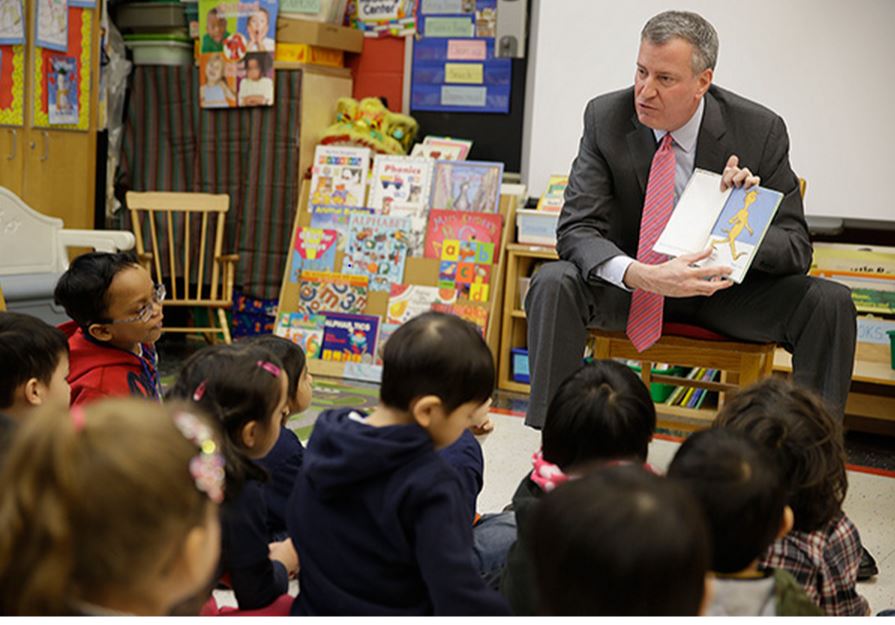
Mayor de Blasio at PS 130

Come from Poorest ZIP Codes

Mayor Bill de Blasio’s universal pre-K program has seen registrations increase by 12,000 children in its second year of operations, with double-digit percentage increases across income levels except for one group: those who need it the most.
New data obtained by ProPublica that compares pre-K registration with a student’s home ZIP code shows that the program added only 195 kids from the bottom 20 percent of ZIP codes by household income.
That is an increase of just under 1 percent for families that make less than $38,000 a year. All other income groups saw large percentage increases from 27 percent to 43 percent.
The stark contrast between those at the very bottom and everybody else is important because decades of academic research have shown that children from low-income families who attend pre-K benefit immensely, but those benefits decrease as you move up the income ladder and may even disappear beyond the middle class. The universal pre-K program was a hallmark of de Blasio’s campaign to make free pre-K education a right for every New Yorker and to narrow achievement gaps, which start very early in child development.
“I honestly don’t see how the mayor will narrow early disparities in children’s learning until he focuses more directly on poor communities, lifting low-income families,” said Bruce Fuller, a UC Berkeley professor who has analyzed the city’s universal pre-K program and provided ProPublica with his analysis of the newest numbers.
Students in the lowest 20 percent of ZIP codes are still the most represented across the program. They make up almost a third of this year’s 65,000 registrations. And city officials said they expect their numbers to go up. Last year, the Department of Educationfirst announced 51,500 registrations, but an additional 1,620 students ended up enrolling. If history repeats itself (and assuming every single new student comes from the bottom group), enrollment growth in the poorest ZIP codes would reach nearly 9 percent this year. But even this hypothetical percentage growth would be three to five times less than the growth of the other income groups this year. It’s also 15 times less than the bottom income group’s growth in 2014 when it expanded by 138 percent.
“Once you successfully engage the first layer of poor income families it gets harder and harder to engage the deeper and deeper layers of families,” Fuller said. “You are now talking about going to the housing projects and knocking on doors, reaching out to the families in Spanish and Cantonese. You are talking about reaching immigrant families who might be mistrustful of government.”
This is exactly the kind of outreach city officials say they are doing.
“We have over 20 full-time people that are dedicated to reaching out to communities all over the city, who speak many languages,” said Josh Wallack, Deputy Chancellor at the city’s Department of Education who directly oversees the pre-K program. “And they have reached out to tens and tens of thousands of families, not only with live phone calls but by attending community events all over the city.” Wallack’s remarks are from an interview that took place last week before these registration numbers were obtained.
Harry Hartfield, the department’s deputy press secretary, stressed the same point in a statement prepared for this story. “We knocked on doors, called families directly, and went to community events across [low-income] neighborhoods to tell families about our free, full-day, high quality programs,” he said. “And we got the message out: two thirds of all students enrolled in Pre-K for All are from households below the median income.
A separate analysis of the data was featured in a story published Sunday. The article touted the mayor’s program with a similar statistic, reporting that 62 percent of children registered this year come from ZIP codes that are below the city’s median income of $51,865. This is true, but left unmentioned were the disparities between those who are close to the median and those who are very much below it.
Overall, eight out of the 12 ZIP codes that saw the largest drops in enrollments since last year fall within the bottom 20 percent. Officials note that in some of these ZIP codes, enrollment in mandatory kindergarten has also decreased, which could mean there are fewer children living in the area. Only four of the 40 ZIP codes that saw the largest increases this year were in the lowest income group.
While an analysis of median income by ZIP code provides only a proxy to understand who is actually making use of universal pre-K, this is the data that the city has been willing to release. It has not released income data for the particular families who enroll in pre-K.
Update, Sept. 18, 2015: After publication, de Blasio’s deputy press secretary Wiley Norvell offered the following comment:
“This is a 2-year expansion, and the first year was heavily focused on low-income communities that benefit most from high quality pre-K. In the ten lowest-income communities, enrollment more than doubled last year. And that focus continued this year, where we pushed and successfully enrolled more than 1,000 children whose families were in homeless shelters. Professor Fuller's bizarre allegation that low-income families aren't served by this new system has been rejected by early education providers and experts over and over.”
Related stories: For more coverage, read ProPublica’s previous reporting onuniversal pre-K.

Friday, September 18, 2015

New York City Council Will Hold a Hearing On The NYC DOE's Restructured School Support System on October 1, 2015

PLEASE SHARE

Hearing on DOE’s Restructured School Support System

The City Council’s Education Committee, chaired by Council Member Daniel Dromm, will hold an oversight hearing, “Oversight: DOE’s Restructured School Support System.  Below is information regarding the upcoming hearing:

Hearing on:    Oversight: “DOE’s Restructured School Support System”
Date:              Thursday, October 1, 2015
Time:              1:00 p.m.  (*public testimony is estimated to begin at or after 3:00pm)
Place:              Council Chambers – City Hall


In January 2015, Chancellor Fariña announced a new streamlined school support system, dubbed “Strong Schools, Strong Communities,” to align the responsibilities of supervising and supporting schools in the offices of the district and high school superintendents.  Under the new system, which takes effect in the current 2015-16 school year, there will be clear lines of authority and accountability under the direction of the superintendent.  The reforms to the structure also include the replacement of the 55 Children First Networks with seven geographically based Borough Field Support Centers (BFSCs).  The new, geographically-based BFSCs, which opened in July, are providing integrated supports to schools across areas of instruction, operations, including finance and human resource support, and student services including health resources and counseling, support to English Language Learners, and support to students with disabilities.  This oversight hearing would provide a better understanding of the restructured school support system.

We invite members of Community Education Councils, parents, students, educators, advocates, and all other stakeholders and interested members of the public to testify at this hearing.  Testimony will be limited to 2-3 minutes per person to allow as many as possible to testify.  Although the hearing starts at 1:00 p.m., the Administration (Department of Education), as well as other witnesses (such as elected officials) have been invited to testify and answer questions from Council Members at the outset, so we do not expect to hear from others until approximately 3:00 pm or later.  Please make sure you fill out a witness slip on the desk of the Sergeant-at-arms if you wish to testify.  If you plan to bring written testimony, please bring at least 20 copies.  If you are unable to attend the hearing and wish to submit written testimony, please email your testimony to jatwell@council.nyc.gov.

Please share this information with any interested groups or individuals. Thank you for your assistance and we look forward to seeing you on October 1st!  Please note - hearing dates and times are subject to change.  For information about hearings and other events, check the Council's website at http://council.nyc.gov/html/action/calendar.shtml or, if you'd like to receive email notices of upcoming hearings, you can sign up at the following link http://council.nyc.gov/html/action/signup.shtml.  All hearings are open to the public. 


Thursday, September 17, 2015

EVENT Alert: Yvette Talley's 3020-a is Open and Public, Starts Friday September 18, 2015

Here is the information for anyone who wants to attend the 3020-a:

Location:
100 Gold Street (under the Manhattan side of the Brooklyn Bridge, across the street from New York Presbyterian Hospital downtown)
3rd Floor, NYC DOE

*save time to go through the security where you must show ID

the hearing starts at 10:00, so please plan to arrive on the 3rd floor no later than 9:45AM. Sit in the waiting room until a room is announced

The Respondent:      Yvette Talley
The Arbitrator is:     Mary O'Connell
DOE Attorney:        Matthew Riordan
NYSUT Attorney:    Paul Brown

You can write notes during the arbitration, but you cannot record anyone, and you cannot talk to anyone, including the Respondent while the hearing is going on.

Other dates (can change without notice, so check this blog)

9/21, 9/22, 9/27, 9/28, 9/29, 10/13

Gertrude Wilks And Establishing Regional School Integration

Gertrude Wilks (right), the daughter of Louisiana sharecroppers, moved to East Palo Alto and was
one of its most prominent leaders in the 1960s.

The problem in New York City is that nothing happens until somebody pays for
 it to happen, and some politician sees some benefits (political/financial) to doing 
it.

Segregation in our public schools has never been fully addressed because no 
one put their political capital behind establishment of a new model.

We need this. 

Betsy Combier, Editor
President, ADVOCATZ

Charters without Borders: Using Inter-district Charter Schools
as a Tool for Regional School Integration

Halley Potter
The Century Foundation

LINK

In 1966, 
Gertrude Wilks, a black mother in East Palo Alto, California, was fed up with the inadequate teaching methods and scarce resources in her son’s predominantly black high school. Then she had an idea. Wilks started a grassroots “sneak out” movement that would send her son—and a hundred other children—to schools in the neighboring predominantly white and wealthy Palo Alto school district. Wilks and the other black parents partnered with white Palo Alto residents who lent their addresses to register the students. Twenty years later, this grassroots movement to fight the racial and socioeconomic segregation of school districts—and the unequal opportunities it created for students—led to the creation of a legal inter-district transfer program for East Palo Alto students that is still in place today.1 

Nearly fifty years later, some parents still go to great lengths to escape segregated, low-performing school districts. In 2011, Kelley Williams-Bolar, a black mother living in Akron, Ohio, used her father’s address to enroll her children in the neighboring suburban school district of Copley-Fairlawn. In Akron, Williams-Bolar’s daughters were assigned to schools in which more than 95 percent of students came from low-income families and which were failing almost all of the state’s academic standards. In Copley-Fairlawn, no school had more than 16 percent low-income students, and every school in the district met state standards for all subjects and grade levels. Like Wilks, Williams-Bolar saw that crossing district lines could be the key to providing better options for her children. Her problem and her approach to solving it are not unique, but her story received national attention because of her dramatic punishment:Williams-Bolar was convicted on criminal charges for fraud and served jail time.2

Today—just like in 1966 or 2011—it is pretty much universally recognized that the school a child attends has a huge impact on that child’s educational opportunities.

Today—just like in 1966 or 2011—it is pretty much universally recognized that the school a child attends has a huge impact on that child’s educational opportunities, but the truth is that, for most families, there just are not that many options for escaping racially isolated, high-poverty, poor-performing school districts. The struggles for school integration that grew out of the civil rights movement have resulted in inter-district integration plans in a handful of American cities, and they have delivered strong results for students. But these programs are few and far between, they have long waiting lists, and they are for the most part struggling to retain funding and popular support in a political climate that has largely forgotten about school integration. We should support the continuation and expansion of these programs, but we also need more approaches to inter-district integration.

Charter schools can and should be part of the solution to addressing inter-district segregation. Although charter school supporters and school integrationists may seem strange bedfellows, there is a growing subset of charter schools committed to school diversity. Furthermore, the charter school model comes with flexibility, funding, and political viability that could be huge assets in the fight for integrated schools.

This issue brief provides an overview of inter-district segregation and existing inter-district integration plans, argues that charter schools should play a greater role in encouraging inter-district integration, and recommends policies and actions to further inter-district integration using charter schools.

THE PROBLEM OF INTER-DISTRICT SEGREGATION


More than sixty years after Brown v. Board of Education, 
our public schools remain de facto segregated by race and class.3 In the Northeast, more than half of all black students attend hyper-segregated schools in which 90–100 percent of students are black or Latino. In the South, where the percentage of black students in 90–100 percent minority schools is now the lowest, still one in three black students attend hyper-segregated schools. The likelihood of Latino students attending 90–100 percent black or Latino schools is nearly as high. And black and Latino students are much more likely than their white and Asian peers to also attend high-poverty schools—a phenomenon that researchers from the Civil Rights Project at UCLA have dubbed “double segregation.” If you are a student in a 90–100 percent black or Latino school, there is an 80 percent chance that at least 70 percent of the student body is low-income. If you are a student in a predominantly white and Asian school (10 percent or less black or Latino), there is less than a 10 percent chance that your school has a poverty rate that high.4 

Importantly, the differences among school districts are more to blame for this stratification than the imbalances within school districts. According to one estimate, differences among school districts are responsible for more than 80 percent of the racial segregation in public schools.5 That is, individual school districts are much more demographically homogenous than broad regions that include multiple districts. Other research finds similar results.6 

Inter-district school segregation is in part a reflection of residential segregation. The concentration of poverty in neighborhoods has been steadily on the rise since 2000, with over 11 million Americans living in neighborhoods in which more than 40 percent of residents live below the federal poverty line.7 And the “double segregation” seen in schools is similarly rooted in neighborhoods. Controlling for family income, black and Latino families are more likely than white and Asian families to live in poor neighborhoods. The average black family earning $50,000 per year lives in a poorer neighborhood than the average white family earning just $20,000 per year.8 

However, segregation among school districts often goes beyond simply reflecting the realities of residential segregation. In the political battles that forge district lines, sometimes poor neighborhoods get pushed out, or rich neighborhoods get pulled in. The results of this process are visible in an interactive mapping by nonprofit EdBuild of the poverty rate for each school district in the United States, which highlights several particularly egregious examples of gerrymandered school districts. In Nebraska, for example, the district outline for Ansley Public Schools looks like a slice of Swiss cheese surrounded by a scattering of crumbs (see Figure 1). Ansley has a higher poverty rate than the other districts in the area, thanks to bizarre boundaries that tack on poorer neighborhoods in outlying areas as islands for Ansley and punch holes within Ansley’s main geographic area to send wealthier neighborhoods to other districts.9

Wednesday, September 16, 2015

Amicus "Friend of Court" Briefs Filed September 16, 2015 in Support of Reversing the Vergara Ruling Against Tenure in California

ADVOCATZ supports any and all efforts to keep teacher tenure as the Law in the US. Our children are relying on us to protect our excellent teachers of all races, genders, and ages.

Betsy Combier, President


Fred Glass
NEWS RELEASE                                                                                September 16, 2015

Contacts:  For CFT:  Fred Glass, (510) 579-3343
                 For CTA: Frank Wells,
 (562) 708-5425

For Information on the Civil Rights Groups Brief:
                 Jennifer Bezoza or Candice Francis,
 (415) 543-9697, ext. 232
      
FOR IMMEDIATE RELEASE

Civil Rights Groups, Researchers, Legal Scholars, and Top Educators
Urge Reversal of Deeply Flawed Vergara Ruling

Amicus “Friend of the Court” Briefs Filed Today Spotlight Harm to Students and Failings of Decision


LOS ANGELES Some of the nation’s top legal scholars, education policy experts, civil rights advocates, award-winning teachers, school board members and administrators filed five amici curiae, or “friend of the court,” briefs with the California Court of Appeal today. The filings shine a spotlight on the numerous and major flaws that would harm students in last year’s decision striking down important due process rights for California educators, as well as other laws governing hiring and layoffs of state educators. The briefs strongly criticize the Vergara ruling on both legal and policy grounds, urging that the decision be reversed.

Prominent civil rights organizations including the Lawyers’ Committee for Civil Rights, Equal Justice Society, Education Law Center, Southern Poverty Law Center, and Advancing Justice-LA filed powerful briefs. These organizations argued that a lack of adequate funding, and certainly not the challenged statutes, is the primary cause of educational inequity, and that in order to close the achievement gap, disadvantaged schools and students must have the support and resources they need to succeed. Arguing that money and race influence competition for qualified teachers and the ability of districts to enact proven reforms like smaller class sizes, the organizations urged the Court to reverse the “…plaintiffs’ attempt to lay blame at the feet of the tenure system for disparities that are the product of other factors, including chronically inadequate funding for education.”

Some of California’s most-honored teachers—including 2012 National Teacher of the Year Rebecca Mieliwocki,(pictured above) and 2014 California Teacher of the Year and national nominee Timothy Smith—wrote of the importance of due process and how these laws ensure they are able to teach without fear of discriminatory, politically-motivated, or baseless termination, and how the laws support the risk-taking often necessary to be an outstanding teacher. They also stressed how striking down the challenged statutes would likely worsen teacher turnover in already disadvantaged school districts. The educators were joined in their brief by the American Association of University Professors, the Arab-American Anti-Discrimination Committee, and the Korematsu Center for Law & Equality.

More than ninety top national education researchers and scholars, including Diane Ravitch, Richard Ingersoll and Eva Baked, took the decision to task for failing to establish any causal link between the challenged statutes and any alleged problems the suit purports to address. These experts argued that current laws play a key role in the recruitment and retention of quality teachers, in a job market where teaching is unfortunately often becoming less and less attractive as a career option for university students. The researchers were also highly critical of the plaintiffs’ proposal to rely on standardized test scores and the “value-added method (VAM)” of interpreting those scores as the major criteria for teacher layoffs due to budget cuts. “VAM scores have been shown to be unstable and to fluctuate dramatically from year to year, so that a teacher could appear very ineffective one year and then very effective the next,” they wrote. “The trial court ultimately failed to consider the possibility that relying solely on VAMs as a way to administer reductions-in-force could drive teachers away from the profession and exacerbate the teacher shortage.”

Past and present school board members, as well as school administrators, filed a brief that argued making teaching a more attractive profession is in the best interest of students. Vergara would make teaching a less desirable profession and would exacerbate a growing teacher scarcity, especially in light of the fact that it is just one among many ongoing orchestrated attacks on educators. Among supporters of the appeal were Kevin Beiser, board member of the San Diego Unified School District; Joan Buchanan, former state lawmaker and trustee of the San Ramon Valley Unified School District; and Steve Zimmer, board president of the Los Angeles Unified School District.
Irwin Chemerinsky
Perhaps most devastating to the decision was the brief by some of the top legal scholars in the country, among them Dean Irwin Chemerinsky and Catherine Fisk of UC Irvine Law School, Charles Ogletree of Harvard Law School, and Pam Karlan of Stanford Law School. These experts said there was simply no basis in the law for finding the challenged statutes unconstitutional or that any causal link had been demonstrated between the statutes and a diminished education for any student. They argued that striking down the statutes could in fact make things worse for students. They wrote, “In this case, the trial court substituted its judgment about desirable education policy and the best way to improve education for students without regard to the harms its policy choice might cause and without regard to the evidence or the law about the cause of educational inequities and the likelihood that the court’s injunction would redress it. The trial court exceeded its role in our constitutional system and its ruling must be reversed.”

Attorney General Kamala Harris, representing the State of California as defendant; and the intervening parties, California Teachers Association and California Federation of Teachers, had filed separate appeal briefs earlier this summer. The amici curiae briefs filed today, as well as a complete list of signatories, can be seen here.

###

The 325,000-member CTA is affiliated with the 3 million-member National Education Association.
The California Federation of Teachers is the statewide affiliate of the American Federation of Teachers, and represents more than 100,000 faculty and school employees in public and private schools and colleges, from early childhood through higher education.


Tuesday, September 15, 2015

In 2008, the UFT Issued a Press Release About ATRs....And Promises Unkept

2008?

Are you kidding? ATRs without a chapter are voiceless by force.

Randi Weingarten


Time for a lawsuit.

See: "CASE STUDY IN PARTISANSHIP:  Critique of the New Teacher Report
"Mutual Benefits: New York City's Shift To Mutual Consent in Teacher Hiring"

Betsy Combier

Price tag of ATRs back in news

Weingarten responded with the following statement:

For immediate release
On September 22, The New Teacher Project reissued a report it had released earlier this year on the city’s Absent Teacher Reserve (ATR), and this time it included a new afterword with updated data and an open letter to UFT President Randi Weingarten and Chancellor Joel Klein that blames the UFT and the Department of Education for not finding permanent placements for the educators in the ATR pool.

Weingarten responded with the following statement:

There they go again. The New Teacher Project, a wholly owned subsidiary of the DOE, curiously weighs in on this issue after it has assisted the DOE in hiring so many new teachers this summer that they cannot even place all the new teachers that were hired, much less the hundreds of veteran teachers who have been trying for months to find permanent placements because of school closings and the current budget crisis.

If TNTP did not have a financial stake in hiring new teachers, they might have pointed out how irresponsible it was for the DOE to bring thousands of novices into a teacher market where the supply already far outstripped the demand. Alternatively, they might have pursued their previous recommendation to create financial incentives for schools to hire ATRs or even propose eliminating the new so-called fair student funding formula as their former president, Michelle Rhee, has done in Washington, D.C., or propose a moratorium on hiring of new teachers until all the ATRs were placed. It declined to take any of these steps, opting instead to bash the UFT because we pointed out errors in their first report – errors they just repeat here, such as the baseless claim that ATRs are six times as likely as other teachers to be rated unsatisfactory.

The facts remain as they were before: When this mutual consent provision was negotiated in 2005, we warned the DOE that unless principals were urged or given incentives to accept ATRs, a number of teachers would not be placed. They told us not to worry and they agreed to the job security provisions as a condition of ending all forced placements. Now instead of implementing a moratorium on new hires until most ATRs are placed, the DOE has exacerbated this situation by continuing to hire new educators from around the nation when there were no jobs for them. It also has left in place a funding formula that, coupled with its phasing out of schools and the budget crunch, makes it hard for principals to hire seasoned teachers who had the courage to work in at-risk schools that have since closed. Also, the DOE could offer incentives for principals to hire ATR teachers, but it has stubbornly refused to do so.

The UFT remains committed to working out ways, as we tried to do all of last year, that would place these valuable ATRs who have been displaced through no fault of their own, which would save the city money. To date, the DOE has declined, ignoring its own actions in creating the situation and seeking to unravel the job security clause. And now TNTP has joined in the pile-on.

The Cheating Scandals Continue in New York City


Cheating allegations rise under de Blasio, continuing a Bloomberg-era trend


Allegations of test-tampering and grade-changing by educators this year are on a pace to exceed the number of complaints made in 2014, continuing a rise in such allegations that began during the previous administration and has persisted under Mayor Bill de Blasio.
The allegations come as New York City has scrambled to respond to a string of reports this year involving academic fraud and grade inflation, such as a high school that let students earn credits without receiving instruction and an elementary school principal who forged student answers on a state exam. Last month, the education department established a $5 million task force to closely monitor schools’ test scores and how they assign credits.
The rise in complaints does not automatically signal a rise in misconduct; it could also indicate that staffers are making greater use of an anonymous email complaint system, for instance. Still, the growing number of allegations suggests that some teachers and principals continue to feel intense pressure to show test score, pass rate, and graduation rate gains, even as de Blasio has tried to de-emphasize those numbers as the primary measures of schools’ success.
“Habits are stronger than words until someone comes in and says you can’t do that anymore,” said Lehman High School math teacher Jeffrey Greenberg, explaining that de Blasio’s rhetorical shifts did not translate into different grading policies or credit-assigning practices at his school last year.
By early August, more than 300 complaints that fall into the category of educator test-tampering or grade-changing had been filed with the office of the Special Commissioner of Investigation, an independent office that handles adult misconduct charges in the school system. That is the same number of such complaints made during all of 2014, making it very likely that this year’s total will be higher.
Last year’s allegations already exceeded the number from 2013, continuing a trend that began under former Mayor Michael Bloomberg. Under Bloomberg, who rated and closed some schools largely on the basis of test scores and graduation rates, the number of educator cheating allegations more than tripled, according to a 2011 New York Times analysis.
De Blasio scrapped his predecessor’s A-to-F school ratings and launched a program to revamp rather than close low-performing schools. However, those schools still could face closure or state takeover if they do not show academic gains within a short period. And despite de Blasio’s ambivalence about test scores, they may soon play a larger role in teacher evaluations under a new state law pushed by Gov. Andrew Cuomo.
“Things are getting worse,” said Arthur Goldstein, an English language teacher at Francis Lewis High School, referring to the state’s teacher evaluations. “The pressure they put on teachers is just terrible.”
The cheating allegations represent only a portion of the complaints made to Richard Condon, the special commissioner of investigation. Last year, his office fielded 5,287 complaints — the most in its 25-year history.
The office investigated just three of last year’s 300 test-tampering and grade-changing complaints and did not substantiate any of them, according to Condon’s spokeswoman, Regina Romain. This year, 10 of those complaints are under investigation, she said.
Still, the office refers most academic fraud allegations to the education department’s investigative unit, the Office of Special Investigations. Education Department spokesman Harry Hartfield would not say how many cheating complaints the agency has received or investigated this year.
The department’s new six-member “Academic Integrity Task Force” will examine the way schools award credits, including their use of credit-recovery courses, which allow students to earn credits for classes they previously failed. While credit recovery has come under new scrutiny, it is a longstanding practice in city high schools that many educators say was ramped up under the Bloomberg administration as schools sought to avoid sanctions tied to student credit-earning and graduation rates.
In addition to the task force, staffers at the department’s new school-support centers will review school data for potential improprieties. And at any school where allegations have been made, officials are investigating student transcripts and the school’s procedures for giving credits and enrolling students in courses, Hartfield said in a statement.
“We have zero tolerance for schools that don’t abide by our regulations,” he said.
The moves suggest the department will try to more aggressively seek out instances of fraud, rather than wait for whistleblowers. They follow a spate of high-profile investigations and media reports about grade inflation and test tampering.
In July, the department removed the principal of John Dewey High School in Brooklyn after a yearlong investigation found that students who had failed classes were able to pass by taking credit-recovery courses that consisted of little more than completing work packets — sometimes without any instruction from teachers. One teacher was told to give students credit simply for attending those courses, the investigation found.
In a series of articles this summer, the New York Post documented more instances of credit-recovery classes that appeared to violate city and state regulations. Several stories focused on grade inflation at William Cullen Bryant High School in Queens, which is now under investigation.
In April, the principal of Teachers College Community School in Harlem filled in questions left blank by third graders on this year’s English exams, according to a city investigation. Shortly after a whistleblower filed a report about the principal, Jeanene Worrell-Breeden, she jumped in front a subway train and later died.
David Bloomfield, an education professor at the CUNY Graduate Center and Brooklyn College, said the new task force could help the city move beyond whistleblowers as its main tool for catching academic fraud by educators.
“I’m hoping that the task force will soon report its findings and recommendations,” he said, “and institute a 360-degree system of prevention, monitoring, and identification.”
 
By: Patrick Wall
@patrick_wall
pwall@chalkbeat.org
Patrick Wall joined Chalkbeat New York in 2013 after covering the South Bronx for DNAinfo New York. He has also written for The Wall Street Journal, The New York Times, Crain’s New York Business, City Limits, and others. He earned a master’s degree from the CUNY Graduate School of Journalism and a bachelor’s degree from the University of Notre Dame. He also taught fourth grade on the South Side of Chicago through Teach for America.