My experience as a former PTA President and current parent/teacher advocate is that the NYC DOE lost its' way years ago, and principals citywide became pawns in zero tolerance for anything that looks like trouble. The result was to blame your weakest link, usually the teacher, and ask questions later - resulting in the re-assignment centers, or rubber rooms.
It seems that people at the DOE are listening to reason, and bringing new policies to schools, namely mediation, peer intervention, and other strategies for intervention.
Its about time, but still not widespread enough. All schools should have alternative dispute resolution programs and policies imbedded in the
Safety Plan.
Let's put "Talk First" policies out there in our schools.
Betsy Combier
betsy.combier@gmail.com
Editor, NYC Rubber Room Reporter
Editor, Parentadvocates.org
Editor, New York Court Corruption
Editor, National Public Voice
Editor, NYC Public Voice
Editor, Inside 3020-a Teacher Trials
When kids get into trouble at school, traditional forms of discipline often lead to more trouble. Is there a more productive way to change behavior?
Two of Leadership
and Public Service High School’s student mediators, Tuson Irvin and Annika
James.
In December 2013, Colleen Walsh, a
social-studies teacher at Leadership and Public Service High School in
Manhattan's Financial District, called one of the school's four deans in charge
of discipline. She had just had a short, heated dispute in the hallway with a
17-year-old student who had his cellphone out, a violation of school rules.
Walsh, then 27, was an energetic teacher, entertaining and assertive, but
something about the way she spoke to the young man, who was not her student,
infuriated him. A junior who could be exceptionally charming but also
combative, he started yelling at Walsh, at which point she contacted a dean in
the hope that he could calm him so they could all discuss what had happened.
Leadership is housed in a tall, narrow building
originally intended as office space, with revolving doors at the entrance and
an echoing lobby. That day in December, the student had already taken the
elevator down to the lobby after the confrontation when he encountered the
dean, who, misunderstanding Walsh's intent, imposed a punishment instead. He
told the young man, who was on the school's basketball team, that he could not
play in that evening's game and that he would also be suspended, because this
infraction came on the heels of several others. The student (who declined to
comment for this article), now even more irate, took the elevator back to the
ninth floor. He burst through the door of Walsh's classroom, where three students
had lingered after class, and faced her, yelling, cursing, accusing her of
lying, ignoring Walsh's repeated requests that he leave the room. Friends tried
to pull him toward the door, but he broke away, then hurled over one of the
classroom's chair-desks. They finally succeeded in pulling him out of the
classroom, at which point a dean arrived.
Some kind of consequence was clearly in order,
the deans and the principal, Phil Santos, agreed. The question was: What would
it be?For the past two decades, how to discipline students has been as hotly
contested a subject as how to educate them. For much of that time, many
public-school systems, including New York City's, have enforced zero-tolerance
policies that require mandatory suspensions for certain offenses. Originally
generated in response to fears about weapons in schools, zero-tolerance
policies, especially in New York, where Rudolph W. Giuliani's "broken
windows" theory had taken hold, signaled to educators that crackdowns on
unruliness of all kinds were in order. Between 1999 and 2009, the number of
student suspensions in New York nearly doubled, according to the New York Civil
Liberties Union, reaching about 450,000 suspensions over the course of the
decade. In that era, infractions that once might have merited a call home, like
shoving another student or cursing, were increasingly common grounds for
suspension.
The broad implementation of punitive suspension
policies gave researchers ample data, the analysis of which has yielded a body
of work suggesting the failure of this experiment in discipline. Suspensions do
not deter bad behavior, numerous studies have found, and most likely feed it by
alienating students from the school community. Other studies show that
suspensions are not just ineffective but inequitable, as students of color are
more likely than white ones to be suspended for the same behaviors. In New York
City, black students made up only 30 percent of all students from 1999 to 2009
but accounted for 50 percent of the suspensions, according to a N.Y.C.L.U.
report. Additional studies show that a student who has been suspended is more
likely to eventually drop out of school or end up in the criminal-justice
system. (In New York, the heavy presence of school safety officers employed by
the Police Department has also been linked to higher numbers of student
arrests.)
As unfavorable statistics piled up, progressive
educators found increasing support for their efforts to dismantle what had
become known as the school-to-prison pipeline. In 2014, federal guidelines on
discipline explicitly noted the harm zero-tolerance policies had done, urging
districts to rethink them. By 2015, in New York City, repeat low-level
infractions — cursing, for example — no longer qualified for suspensions. In
order to suspend a student for "defying or disobeying the lawful
authority" of school staff, the kind of catchall violation that was
disproportionately applied to students of color, a principal had to obtain
approval from the Education Department. Between July 2015 and that December,
the number of suspensions in New York dropped by 32 percent, compared with the
same period a year earlier.
The federal guidelines suggested that educators
consider, among other alternatives, an approach called restorative justice, which
differs radically from zero tolerance. Restorative justice is built on values
like community, empathy and responsibility; in its specifics, it asks students
and teachers to strengthen connections and heal rifts by sitting on chairs in
circles and allowing each participant to speak about how a given incident
affected him or her.
It could easily be dismissed as an impossibly
amorphous process for overworked teachers and volatile students were it not for
its success so far, in programs in Denver and Oakland that started in the
mid-2000s. Schools employing restorative justice, or restorative practices, as
it's sometimes called, experienced such significant results — lowered
suspension rates, higher graduation rates, improved school atmosphere — that both
cities, as well as San Francisco, now offer restorative-practices training for
all educators. New York's Education Department is investing in training its own
faculty, and Schools Chancellor Carmen Fariña has expressed her enthusiasm for
the approach.
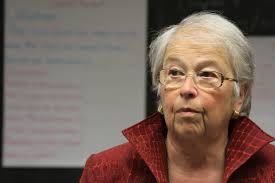 |
| Chancellor Carmen Farina |
Leadership and Public Service High School first
started experimenting with restorative practices in 2011, when Phil Santos
became principal. Since then, every year, he has requested more resources and
training for his teachers, making him, within New York City, a relatively early
adopter.
As committed as he remains, making the shift to this new approach has
been, as Santos describes it, "exhausting" and "messy";
changes in teacher attitudes and student behavior come slowly. His school's
experience is emblematic of the challenges schools face as educators try to
replace a discipline policy that removes students from the school with one that
aspires to help them become peaceful citizens in society.
As the staff of Leadership tried to apply its
new philosophy to the incident involving Walsh and the student, the process
would reflect many of the tensions that drove up suspension rates in the first
place — issues around race and power that even the most progressive educators
struggle to talk about honestly, all the while knowing that doing so is
essential to making real change.
Santos grew up in Queens in the '80s, with the
kind of childhood that makes it easy for him to empathize with the students in
his school, 70 percent of whom qualify for free lunch and 80 percent of whom
are students of color. His father was incarcerated for part of his childhood,
and his mother, he says, was not stable enough at the time to care for a child.
Instead he was raised by his great-grandmother, great-aunt and great-uncle. In
high school, Santos became active in his youth church and considered becoming a
pastor before switching to education. He is a trim man who carries himself with
a brisk, military bearing. He intimately understands, he says, why so many of
his male students feel compelled to fight to prove themselves. He was born with
one hand and could have been a target. "If I went to a new school, if I
didn't fight early on, the rest of my time there would have been harder,"
he says.
Santos arrived at Leadership, where most
incoming students are performing below grade level, wanting to make changes,
fast. At times, in his righteousness, he approached his staff as if he were
taking on that first fight at a new school. "If you are unwilling to hold
our students to high expectations," he wrote in a newsletter to teachers
early in his tenure, "provide the necessary support, restore damaged
relationships and demonstrate unconditional love, then Leadership and Public
Service is not for you."
Leadership had long been the kind of school
where many teachers saw their job solely as teaching; managing discipline was
the role of deans, whom they would call to the classroom "for anything
more than the crumpling of a paper," says Sara Mitchell, a music teacher
who started at Leadership two years before Santos. Santos's priority was to
shift that habit; he urged teachers to take the time to talk to the student,
calmly, outside the classroom, to work on building the relationship — even to
take responsibility for possibly inflaming a situation with a harsh tone of
voice.
Many teachers decided that the school, under
Santos, was not, in fact, for them. Eleven out of 51 left at the end of his
first year. Some would have retired or moved anyway, but others were skeptical
about his empathy-based approach. ("What are we, going to get in a circle
and sing 'Kumbaya'?" one was heard to mutter during a faculty meeting.)
Some worried that Santos wanted to cede too much control to students, while
others felt he wanted more work from them on their own time than was
reasonable. "I think they felt, Are you saying I am not pushing myself
enough already?" says Candace Thomas-Rennie, a guidance counselor at
Leadership whom Santos hired in his first year as principal. "That's
insulting for a veteran who has the results to back up their own
practice."
Santos replaced the staff members who left with
a diverse group of young teachers and recruited a new dean, Erin Dunlevy, a
32-year-old former Spanish teacher who had been trained in restorative
practices. Before the school year even started, she spent a few hours one day
introducing the principles of restorative justice to about 20 students who were
chosen because they had leadership potential but also were often in conflicts.
Dunlevy knew change would take time, but she was still rattled when, within the
first month of school, one girl from that group brawled with another girl.
Dunlevy, who tried to intervene, ended up in the emergency room with a broken
toe, after a fire extinguisher that one girl threw at the other landed on her
foot. "There was a lot of heavy lifting to do at that school,"
Dunlevy says; later that year, a student fired a gun at a bathroom urinal.
(That student and the girls who had fought were suspended.)
She continued to work closely with students as
well as the other disciplinary deans, teaching them how to conduct circles that
would resolve conflicts. The training emphasized each party involved owning up
to his or her responsibility and making amends, with an honest conversation or
an action (a student who had left a classroom in disarray might help the
teacher clean it).
She also coached teachers on how to use language
that set a welcoming rather than punitive tone. "As opposed to, 'You're
late, sign this late log,' it's, 'Hey, this class is not complete without you —
I need you to be here,' " Dunlevy says. But she frequently felt the staff
had not yet had enough time to internalize the philosophy. "A teacher
would say, 'I need you to restore this kid,' " she says, "as if it
was my job to fix this kid, instead of what was supposed to be happening, which
was the teacher making an effort to repair the relationship." She
recognized that it takes work for teachers to interrupt a classroom lesson to
step outside with a troublesome student, or to ramp up the psychological
support they offer. 'It's a big ask," she says. "And they're working
incredibly hard to begin with. I get it."
Carolina Ibáñez, a Spanish teacher at
Leadership, said she always tried to engage with students one on one but
acknowledged that if there was a conflict, sometimes she "really did not
want to have the conversation." For her, the challenge of restorative
justice entailed internalizing that "being a teacher means addressing more
than what's in the book. To get to the book, you really have to address the
child's emotional state first." Even more challenging, Dunlevy says, the
shift requires teachers to rethink the very concept of justice, rejecting a
model of punishment in which most were trained and most likely raised.
When the school year ended in 2014, there were
140 total suspensions at Leadership, down from 230 the previous year.
Randy Spotts (left), head dean at Leadership,
and Phil Santos, the school's principal.
Colleen Walsh, the teacher whom the student
confronted in her classroom, felt prepared to help champion restorative
justice. She was one of seven teachers at Leadership who took part in a
five-day training in restorative practices during the summer of 2013 provided
by the Morningside Center for Teaching Social Responsibility, a nonprofit group
that the New York City Department of Education has hired to work with its
schools. "I felt passionate about it," says Walsh (who left the
school last year to work closer to her home in Queens). "I was like the
No. 1 person." Even before Santos and Dunlevy arrived, Leadership had
deans to whom students turned for emotional support, including Randy Spotts,
who has been at the school since 1995. In 1970, Spotts was one of a few black
students who enrolled at a West Virginia elementary school that had
desegregated a year earlier. His grandmother frequently reproached his school's
administrators for the unequal treatment of black students. When Santos first
spoke to Spotts of "the educational violence" experienced by students
who are pushed out of schools through suspensions, Spotts immediately
understood. For years, one of his primary responsibilities was suspending
students. "My personality had always been more restorative," Spotts
says, "but my practice, because of the models that I was inducted into,
were not."
Despite the similarity of their perspectives,
Walsh and Spotts had radically different ideas about the consequences the
student who turned over the chair-desk should receive. Walsh felt that at least
a three-week suspension would be appropriate. Several other teachers (most of
them white, Spotts noted), who had had their own run-ins with the student, felt
that the incident merited a 90-day suspension. Initially, Santos was
sympathetic to that sentiment. "I know my staff needs to feel safe in
order to function," he says. He ultimately decided to ask the D.O.E. for a
30-day suspension.
Spotts, who was also the coach of the student's
basketball team, was shocked by Santos's decision. A three-day in-school
suspension, he thought, was all that was in order, especially given the
restorative-practices training he had received under Santos. "It wasn't as
if he had thrown the chair at her, or near her," he says. No one had been
hurt or even touched.
As the issue was being debated among the
faculty, Santos received a text from a white teacher that stunned both Santos
and Spotts, when he learned about it. "If a black male student hurts a
white female teacher," Santos recalls it saying, "this school is
going to have problems." The text reinforced Spotts's thinking: that the
school's response to the incident would have been different had the aggrieved
teacher been black, or had the student, who is black, been white. He and Santos
had an intense argument about the decision Santos had made, with Spotts
suggesting that Santos needed to examine his own perspective on race.
"I had never realized just how deeply race
penetrated all of our actions, whether we are conscious of it or not,"
Santos, who is of Puerto Rican, Filipino and Cherokee descent, says now.
"It made me, as a Latino man, re-examine my own practice, to think about
my own internal biases." The Department of Education ultimately granted a
10-day suspension for the student. (Santos now thinks that his 30-day request
was too harsh.) When Santos took Walsh aside and told her, he also asked her
for her help. Santos wanted her and the student to take part in a restorative
circle, to smooth his re-entry after his suspension.
Walsh's first impulse was to refuse. "I was
disrespected in a threatening manner," she says, "and I felt, in a
way, like, 'What do I owe anybody?' " Even she was surprised by how
powerfully she resisted the idea, given her training. She knew other teachers
thought she would be crazy to consider sitting down with the student. "But
I was trained in it, I was all about it," she says. "Now I had to
live up to it."
The day the student returned to school, he
headed to Santos's office, a converted classroom on the 12th floor, for a
restorative circle. A dean at the school, Melissa Ramos, sat on one side of
Walsh, as her chosen advocate, and Santos sat on the other; Spotts, the
student's advocate, sat beside him, along with a guidance counselor who served
as the circle's facilitator. Each person took a turn holding a "talking
piece" — in this case, a squishy ball — that designated whose turn it was
to speak, free of interruption.
Santos recalls Walsh's acknowledging that she
"sort of came at the student," meaning her tone was more aggressive
than necessary, although she remembers making no such admission. But she knows
she had the chance to express how she felt when the student burst into the
room. The student, those who were present recall, did not say much in the
circle — but he listened. Walsh does remember his trying to explain why missing
the basketball game upset him. And she keeps locked in her memory the moment
near the circle's close when he apologized. "With a low, sad manner, he
said, 'I'm sorry, Miss Walsh,' " she recalls.
In that moment, Walsh says, she was able to see
him as a young, vulnerable person; she could once again see why he might be
angry. "It's not to say we can let kids get away with disrespecting
teachers," she says, "but there's always a reason. And if you can
remember that, it helps you stay calm."
Even after the circle, she dreaded the idea of
seeing the student in the building's elevators, but the next time they crossed
paths, he seemed happy to see her. "How are you, Miss Walsh?" he
wanted to know. She was, at that moment, "knocked off my feet," she
says. "It was such a relief. I could focus on my kids and my lessons, and
not be thinking about this kid — we were cool." The following year, she
worked with the student after school, helping him prepare for his history
Regents exam.
That student, for the remainder of his time at
the school, continued to reflect what Santos considers the sometimes quixotic
reality of restorative practices: Despite circle after circle, the student
remained volatile, testing teachers' patience for an approach that seemed to
yield, in his case at least, few results. But he graduated — with the aid of
Walsh, one more person helping him move forward toward adulthood.
One morning this past June, as the school year
drew to a close, Melissa Ramos sat patiently at a desk, one of about 20 in a
circle, waiting for students to finish filing into the room. She was teaching a
class in restorative justice, which trained students in how to facilitate and
be members of circles and also addressed students' emotions. "As you know,
we don't let the late birds stop us from doing what we need to do," Ramos
said to get the class going. Her words were neutral, but she spoke with enough
authority that you could sense the late birds would know how she felt when they
did arrive.
Carolina Ibáñez, a Spanish teacher at
Leadership. Ibanez was
one of the first teachers to be trained in
the school’s restorative-
practices model.
The class was a mix of
students, some who never got in trouble and others who had had their share of
suspensions. Each student was handed a slip of paper with a topic on it, and
each took a turn holding a soft, small globe, discussing what he or she had
learned about the topic.
Tuson Irvin, 17, then a
junior, looked down at his topic and smiled: conflict. It was a subject he knew
a lot about. “What I have learned in this class is that when someone is
speaking loudly at you, rather than responding with the same tone,” Irvin said,
“all you have to do is be quiet. Because to be mature about a situation and
walk away or sit there and talk low — I have seen that, hey, it works. Not only
does it enrage the other person, it is satisfying — like, Hey, I kept my
composure. And the other person is thinking, I guess I have to find another way
to come at this person rather than yelling at them.”
Irvin had earlier
received additional training as a student leader in restorative justice —
someone who stepped in to help other students resolve conflicts, or served as
an advocate for them in their own circles. Irvin, who has a strong, booming
voice and a firm handshake, can seem like the kind of student whom
administrators trot out to tout their pet policies, on message and polite. But
during his freshman year he was suspended numerous times (among other reasons,
he refused to take off his beloved Mitchell & Ness baseball cap). Since
then, he had built a relationship with Santos, who called him into his office
in his sophomore year to talk to him about the problems they were having. He
even apologized to Irvin for having spoken harshly to him, which Irvin said
“left a big impression on me. What I saw was, Hey, this guy doesn’t want me to
sit here and be a pain all day. He is trying to help me improve.”
In Ramos’s
restorative-justice class, a student tossed the ball to a junior named Annika
James. A tall young woman with her hair in braids, James spoke quickly and
quietly, her shyness belying a history of fighting with other girls. Her topic:
“anger management.” “I feel like I have my anger managed,” James said. “I
learned to choose my battles.” Now she, like Irvin, was a restorative-justice
team leader. Santos had also been pleased to see her college bound, taking A.P.
classes. “I really think Annika is one of those kids we would have lost without
restorative practice,” he says.
Only a small portion of
the school could take Ramos’s class, but last year, for the first time, every
student at Leadership attended a weekly class that was conducted in a circle,
with a curriculum focused on building the psychic muscles that restorative
justice demands: how to cope with stress, listen, empathize. Santos thinks that
program, which made every student at the school familiar with circles, helped
solidify the previous years’ efforts. “Students started coming to us, asking
for circles,” he says, trying to head off confrontations before they happened.
As the staff and student body were forming close
connections among themselves, Santos decided that the school was ready to
tackle an issue that restorative justice is also intended to address: race. In
New York City, as the number of suspensions has dropped, the racial disparity
in how punishment is applied has persisted. Santos was aware of studies finding
that white, and to a lesser degree, black teachers have lower academic
expectations for black students than they do for white students. And he had
seen, through his own experience, how race can complicate seemingly
straightforward matters of discipline. To try to address those issues, last
fall he instituted a weekly facultywide circle that met after school over the
course of the school year. To guide the discussions, he used a book called
“Courageous Conversations About Race,” by Glenn E. Singleton. The book asks
participants to dig deep into their own uncomfortable feelings about race, and
to consider how that range of reactions might affect the educational experience
of students of color. It asks participants to answer questions designed to make
people push past politeness and self-protection. One example: “Can you recall a
time when race was the topic of conversation and you became silent and/or
shared something that was less than your truest feeling in fear of what others’
response might be?”
Many teachers didn’t
want to take part in the program. Once the conversations began, Santos received
texts from teachers who told him they worried the project was causing racial
tensions where there had been none before. One teacher told Santos that his
student saw him carrying “Courageous Conversations” and said, “Oh, that’s that
book that all the teachers hate.”
Marcellus Waller, a white
33-year-old social-studies teacher, often found himself uncomfortable in the
smaller breakout discussions, when topics like white privilege arose. “For me,
a white male in America, some of those conversations were hard,” he says. “I
feel bad for just being me.” Some educators of color felt insulted by the
suggestion they, too, might be biased. “They want to know, as a black or Latino
teacher, why is this even an issue?” Santos says. “And we’re trying to get them
to see maybe it is or it isn’t, but race is something we have to talk about,
because we live in America, and race is an issue in education.”
Thomas-Rennie, the
school’s guidance counselor, who is black, felt strongly that the conversations
were important, but worried that they were so uncomfortable that they set the
faculty back, at a time when it had just been trying to cohere around
restorative practices.
“For people to understand how race impacts how we
function as a school was a difficult thing to connect with,” she says.
Restorative practices, high academic expectations — those were relatively
straightforward concepts; tackling head-on how race affected those issues was
more challenging. “There was emotional pushback,” she says. “And even for a
black woman, myself, the issues of race and the complexities and the deep roots
— it can be exhausting. But race is like the never-ending song of our work. I
recognize that if we are not willing to face this other piece, we are only
going to go so far.”
Thomas-Rennie had opened
up, in one discussion, about the self-hatred she felt as a young girl, wishing
her skin were lighter. Later, a Dominican-American teacher approached her to
say she felt the same way as a girl. Because that teacher was so light-skinned,
“I wouldn’t have assumed we could connect around something like that,”
Thomas-Rennie says. She felt closer to that teacher, and generally enlightened.
“These conversations give the staff a chance to be more authentic with each
other,” Thomas-Rennie says. “And if we are more authentic with each other, that
will automatically translate to how we communicate with the students.”
Last year, suspensions
at the school fell to 64, a 60 percent drop from the year before and one of the
city’s most significant changes. Suspension rates dropped citywide, which would
be expected, given the change in the discipline rules; but the Morningside
Center found that the rates dropped even more in those schools where teachers
were trained in restorative practices and had follow-up coaching. Ideally,
teachers at these schools were not just finding alternatives to suspension but
seeing fewer conflicts.
Santos is far from ready
to consider his tenure a success; much of his staff still hasn’t been trained.
“Sixty-four suspensions, that’s still a lot,” he says. The school still labored
under chronic absenteeism rates that were higher than the citywide average and
college-readiness rates that lingered below the average. While studies have
shown that restorative practices curb suspensions, research on their influence
on test scores and grades is inconclusive.
Santos remains committed
to restorative practices, though he rarely discussed them without acknowledging
how trying they could be. “Let’s say you met with a group of students for an
hour, and you think there’s been major progress — but then one of the kids gets
on social media and just destroys everything you’ve attempted to do,” he says.
“And then you have to circle again. Because what are you going to do, let them
fight? Suspend everybody? You need to circle, and keep circling, because what’s
the alternative?”
Randy Spotts, the
21-year veteran dean, has seen all too much of the alternative, first in the
South Bronx, where he worked in the ’80s and watched countless students end up
in prison or dead, and then at Leadership. He has thought a lot, over the
years, about a student he personally suspended over and over again, then ran
into on the subway several years later. “You know, Mr. Spotts, I could never
get going, because you just kept suspending me,” the young man told his former
dean. He wasn’t accusing Spotts; he was just pointing it out, as if it was
something they could both feel wistful about now. Spotts often thinks about
that student and others he wishes he could have helped more, could have kept in
school and off the street. “I think about what I was doing to these kids. And I
think to myself: Did we really have to do it that way?”
----------
Susan Dominus is a staff writer for
the magazine. She last wrote a Letter of Recommendation for the video game Just
Dance.
Trigger Warnings, Safe Spaces and Free Speech, Too
I didn’t get the University
of Chicago welcome
letter that made the rounds on the internet earlier this summer. I’m a senior
this year, and the message from Jay Ellison, the dean of undergraduate
students, was for the incoming class: Don’t expect trigger warnings or safe
spaces here. The university, he said, was committed to free expression and
would not shield students from ideas they disagreed with or found offensive.
The implication was that
students who support trigger warnings and safe spaces are narrow-minded,
oversensitive and opposed to dialogue. The letter betrayed a fundamental
misunderstanding of what the terms “trigger warnings” and “safe spaces” mean,
and came across as an embarrassing attempt to deflect attention from serious
issues on campus.
A trigger warning is pretty simple: It consists of a
professor’s saying in class, “The reading for this week includes a graphic
description of sexual assault,” or a note on a syllabus that reads, “This
course deals with sensitive material that may be difficult for some students.”
A safe space is an area on
campus where students — especially but not limited to those who have endured
trauma or feel marginalized — can feel comfortable talking about their
experiences. This might be the Office of Multicultural Student Affairs or it
could be Hillel House, but in essence, it’s a place for support and community.
This spring, I was in a
seminar that dealt with gender, sexuality and disability. Some of the course
reading touched on disturbing subjects, including sexual violence and child
abuse. The instructor told us that we could reach out to her if we had
difficulty with the class materials, and that she’d do everything she could to
make it easier for us to participate. She included a statement to this effect
on the syllabus and repeated it briefly at the beginning of each class. Nobody
sought to “retreat from ideas and perspectives at odds with their own,” as Dean
Ellison put it in the letter, nor did these measures hinder discussion or
disagreement, both of which were abundant.
Of
course, not every class calls out for trigger warnings — I’ve never heard of
them for an economics course. Likewise, plenty of students will never need to
visit a safe space. But for those who do, support systems can be a lifeline in
the tumultuous environment of college, and are important precisely because they
encourage a free exchange of ideas.
A little heads-up can help
students engage with uncomfortable and complex topics, and a little sensitivity
to others, at the most basic level, isn’t coddling. Civic discourse in this
country has become pretty ugly, so maybe it’s not surprising that students are
trying to create ways to have compassionate, civil dialogue.
The really strange thing
about the Ellison letter, though, is that it positioned itself in opposition to
resources the University of Chicago has already built: Instructors already
choose whether to use trigger warnings in their classes, and there are many
safe spaces on campus. Dean Ellison is even listed as a “safe space ally” on
the website of one program run by the Office of L.G.B.T.Q.
Student Life.
If, as a university
spokesman says, no program or policy is set to change,
why release this condemnation at all?
The administration wants to
appear as an intellectual force beating back destabilizing waves of political
correctness that have rocked college campuses. But the focus of student
protests hasn’t been the lack of trigger warnings and safe spaces.Instead,
many protesters want the university to evaluate how it invests its money,
improve access for students with mental illnesses and disabilities, support
low-income and first-generation students, and pay its employees fair wages.
They have been pushing for more transparency in the school’s private police
force, which has resisted making most of its policies public in the face of
complaints. The university is
also under federal investigation over
its handling of sexual assault cases.
Yet, the administration has refused to meet with student groups who have asked to
discuss these issues, and it has threatened to discipline students who staged a sit-in protest. The university even
hired a provost who specializes in corporate crisis management and dealing with
“activist pressure.” While the university accuses students of silencing
opposing voices, it continues to insulate itself against difficult questions.
In this context, it’s hard
to see the dean’s letter as anything other than a public relations maneuver.
While students are being depicted as coddled and fragile, the administration is
stacking bricks in its institutional wall to avoid engaging with their real
concerns.
It’s too bad, because there are certainly legitimate debates to
be had over speech in academic settings. The Ellison letter, for example,
included a denunciation of attempts by students to disrupt university-sponsored
events featuring controversial speakers. But that has little to do with trigger
warnings and safe spaces.
Regardless
of the posturing of academic administrations, in trigger warnings and safe
spaces, students have carved out ways to help, accommodate and listen to those
around them. Campus advocacy groups will not be deterred by a letter, as their
goals have nothing to do with censorship and everything to do with holding
universities accountable to the communities they are supposed to foster.
This is the first in a
series of dispatches by college students, professors and administrators on
higher education and university life, at nytimes.com/oncampus.
Sophie Downes is a student at the University of Chicago.


